

Azerbaijani Foreign Policy in 2025: Key Highlights
The year 2025 marked a period of adjustment and consolidation in Azerbaijan’s foreign policy. From its immediate vicinity to neighboring regions, Baku approached its external environment not as a challenge to be reacted to, but as an emerging architecture to be proactively shaped in line with its vital interests. The formalisation of peace with Armenia and the gradual normalisation of relations with Russia and Iran coincided with intensified competition among great powers to anchor new transit, energy, and digital corridors stretching across Eurasia. Azerbaijan continued to advance a multi-vector foreign policy that sought strategic autonomy between rival centres of power, while translating military gains of the Karabakh wars into diplomatic, economic, and normative capital.
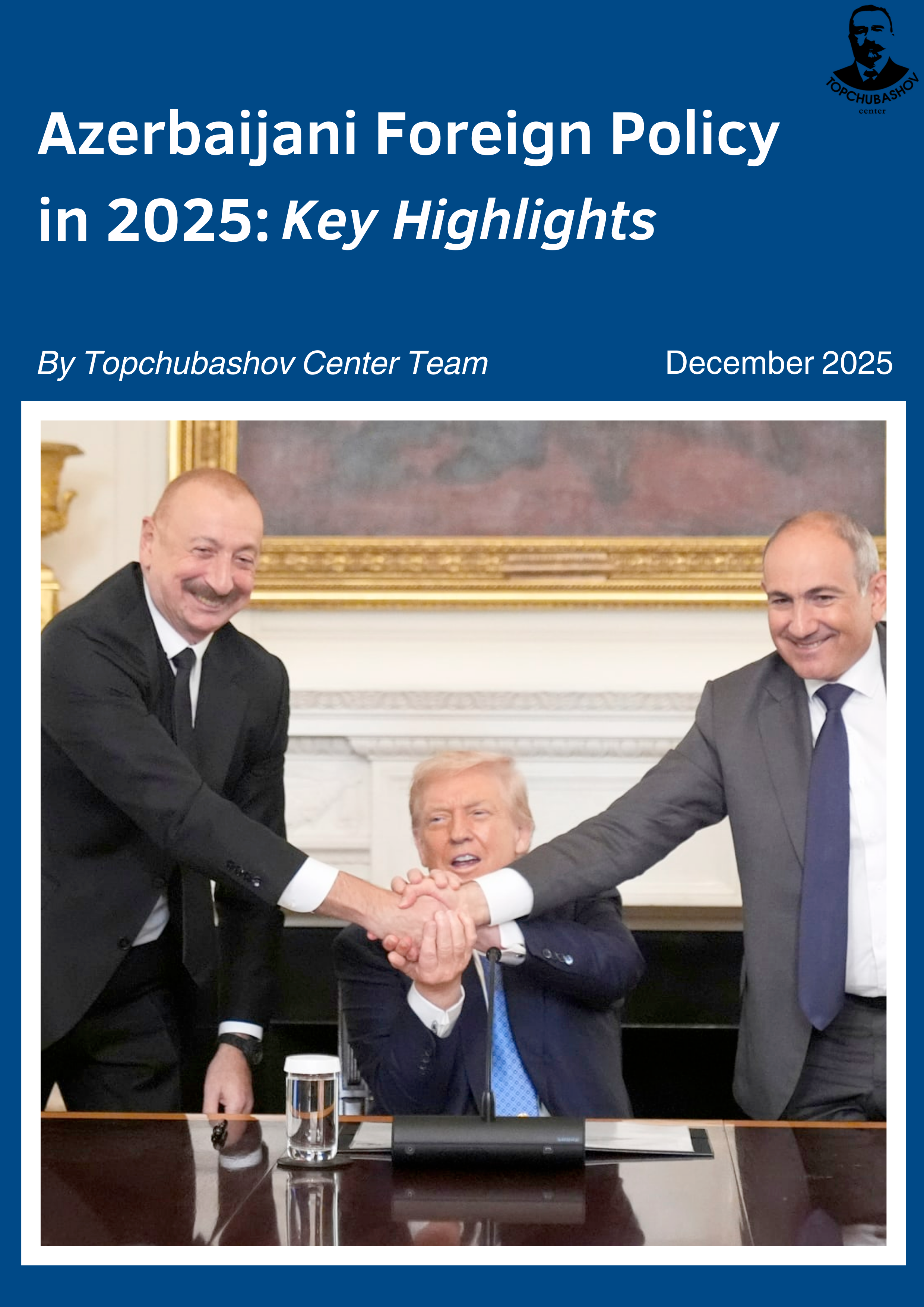
Three overlapping transformations framed Azerbaijan’s foreign policy in 2025, reshaping how Baku views the emerging regional and international (dis)order. First, the consolidation of peace with Armenia through the signing of the draft peace agreement in March and the Washington Declaration in August helped close the chapter of conflict that defined the country’s security doctrine for more than three decades.
Second, Azerbaijan’s expanding role in Eurasian energy and transport geopolitics has elevated connectivity diplomacy from a mere policy instrument to one of the organizing principles of its foreign policy.
Third, and most importantly, Azerbaijan sought to recalibrate its major-power relationships in an increasingly multipolar and fluid geopolitical environment.
This annual review report purports to map Azerbaijan’s foreign policy in 2025 within these broader dynamics. It proceeds region by region, while tracing several cross-cutting themes: the evolution of Baku’s multi-vector foreign policy doctrine; the shift from conflict management to post-conflict order-building (or “winning the peace”); the centrality of energy, transport, and digital corridors; and the tensions between zero-sum calculations and pragmatic cooperation.
Download the full report.