


Topchubashov Center
Expert opinion 2 min read

EU monitoring mission for Armenia and Azerbaijan

EU monitoring mission for Armenia and Azerbaijan
Shujaat Ahmadzada Research Fellow Published

Listen to this article Read by an AI voice

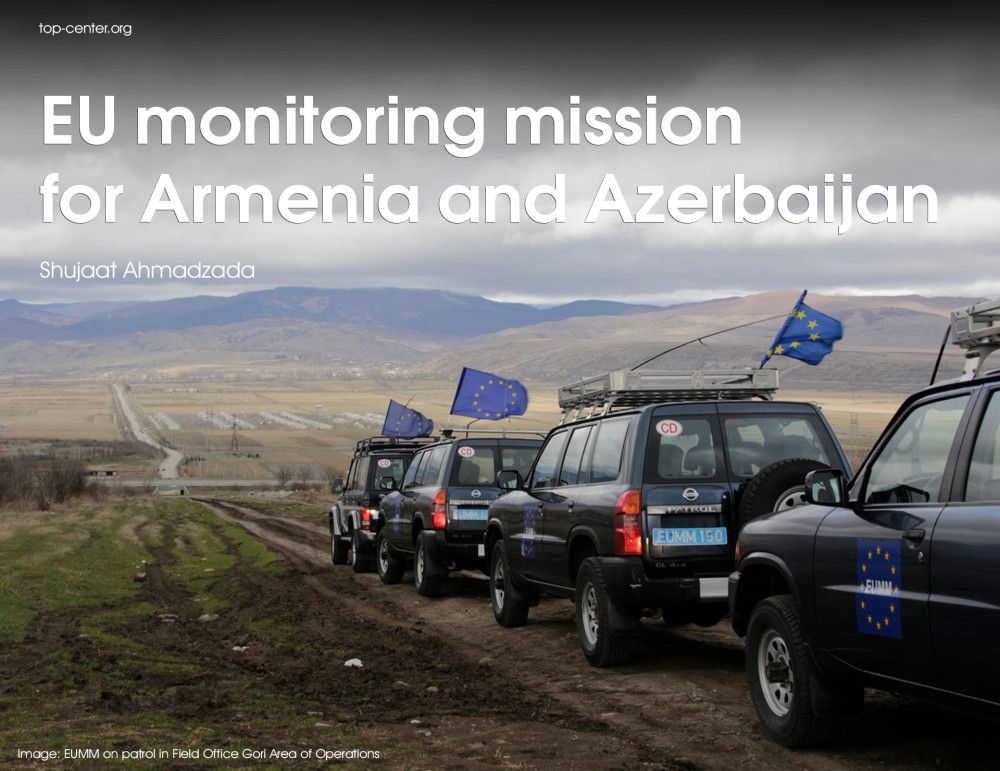
The European Union's most recent statement regarding the monitoring mission sent to the regions of Armenia's border with Azerbaijan made clear the lack of knowledge regarding the mission's details. The Azerbaijani side claimed that the mission had been increased to 50; however, the most recent statement makes it abundantly obvious that the composition will stay at 40 as initially agreed. The phrase "delimitation of the international border" in the declaration also supports what the Azerbaijani side had previously articulated. It should be noted that there was no mention of how the mission will aid in the delimitation process in the initial statement.

The mission will aim to "restore peace and security" in the area, according to the most recent statement. This alone can be interpreted as a message from Brussels to Baku and Yerevan to adhere to the ceasefire as strictly as possible during this period. Despite being on the Armenian side of the border, the mission will maintain regular contact with the Azerbaijani side as evidenced by the mission's commitment to "building trust" in the statement. It should be noted that Baku's skepticism about the EU mission is more related to past experiences: the OSCE monitoring mission, which operated for many years on the Karabakh contact line, not only did not help prevent incidents but served to freeze the conflict. From this point of view, Baku is interested in solving its disputes with Yerevan quickly instead of internationalizing them.

The statement makes a specific point clear. The mission is therefore not permanent and won't continue longer than two months, according to the EU. This alone contradicts Armenian PM Nikol Pashinyan, who argued for a "permanent international presence," and it demonstrates that so far Yerevan has not been successful in bringing a permanent international presence to the border regions. A common indication that the parties are expected to deal with a political agreement during this time frame is the mission's limitation with a two-month deadline.

Related work

Expert opinion

US foreign policy before midterm election

As the US midterm election is approaching, the correlation between President Trump’s statements and actual US policies, gets more and more uncertain. And while his occasional eccentricities on Twitter or during rallies with supporters, have become part of a po...

Murad Muradov, 27 October 2026

Expert opinion

Connecting Central Asia and the South Caucasus

On November 15, Azerbaijan formally joined the Central Asian Consultative Meetings, expanding what was known as the Central Asian Five (C5) into a Central Asian Six (C6). Many in Central Asia find it surprising. But when viewed through the lens of recent geopo...

Gulkhanim Mammadova, 1 December 2025

Expert opinion

Azerbaijan joins the C5: implications for Eurasian regional architecture

When the long-standing C5 format of Central Asian cooperation formally expanded into a C6 on 15 November in Tashkent, Azerbaijan’s accession was framed as a natural extension of historical and linguistic affinities. Yet behind the rhetoric lies a structural tr...

Gulkhanim Mammadova, 21 November 2025

Expert opinion

Kazakhstan joins the Abraham Accords: Pragmatism or Symbolism?

Kazakhstan’s accession to the Abraham Accords—anticipated in some political circles—may still raise eyebrows. Unlike the original signatories, who were establishing relations with Israel from scratch, Kazakhstan has long maintained cordial ties with the Jewish...

Rusif Huseynov, 9 November 2025

Expert opinion

13 June attack: quick comments

In the most extensive attack on Iran since the country’s 1980-88 war with Iraq, Israeli forces have launched multiple waves of nationwide bombings. The attack is ongoing and believed to be the opening shots of a wider campaign to degrade Iran’s military comman...

Murad Muradov, 13 June 2025

Expert opinion

Historic First in Tbilisi: Armenia, Azerbaijan and Georgia trilateral talks

On April 17, Tbilisi hosted the first-ever formal trilateral meeting between the foreign ministries of Armenia, Azerbaijan and Georgia. According to official statements, the primary aim of the meeting was to create a platform for open dialogue and to explore p...

Gulkhanim Mammadova, 17 April 2025

Expert opinion

Munich speech, 18 years later

The Munich speech of the U.S. Vice President J. D. Vance will definitely enter the textbooks of the future as one of the harbingers of a new historic period. This speech has been arguably more shocking than Vladimir Putin’s diatribe he made on the same stage 1...

Murad Muradov, 19 February 2025