


Topchubashov Center
Expert opinion 2 min read

If there's no war tomorrow: what it might mean

If there's no war tomorrow: what it might mean
Murad Muradov Co-founder, Deputy Director Published

Listen to this article Read by an AI voice

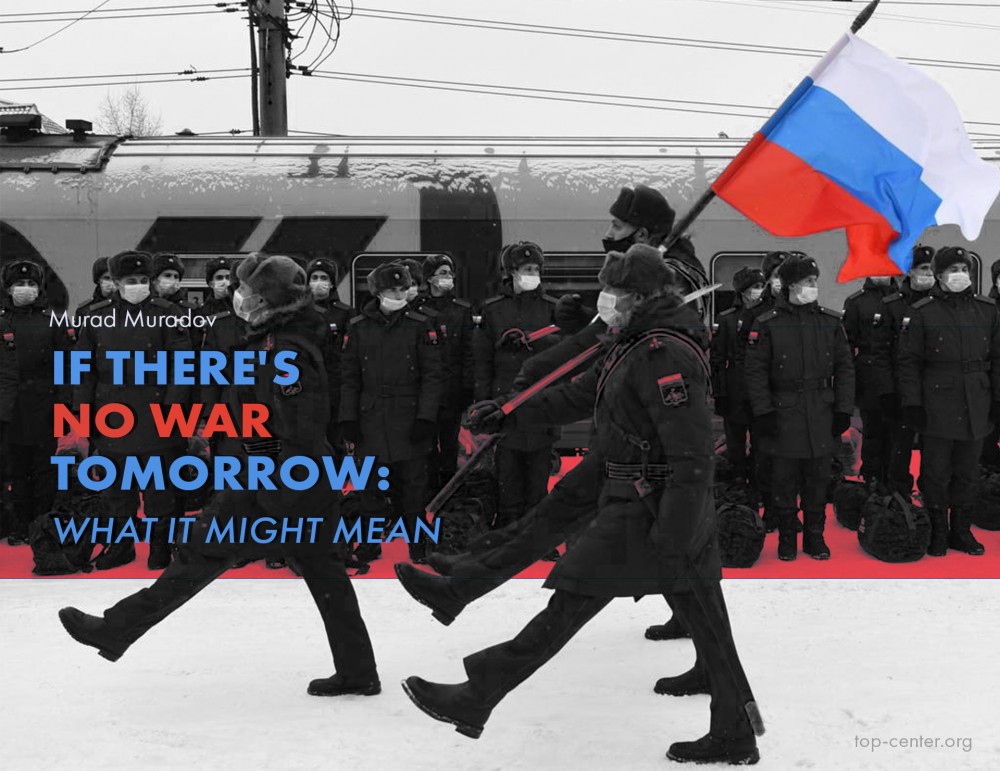
When it comes to the ongoing crisis around Ukraine and a supposed Russian invasion, to understand the situation better it is necessary to find out in what cases the escalation may not happen and how each of them should be interpreted.

If we exclude propagandistic explanations, truisms and repetitions, there are only 3 scenarios that could explain a non-escalation should it happen:

1) Ukrainian unilateral surrender, i.e. full UNILATERAL compliance with the Minsk agreements, guarantees of the neutral status and withdrawing the NATO pledge, de-facto recognition of Crimea etc. According to the latest statements of the Ukrainian government has already made it clear, even 50% of this is impossible, hence this scenario remains only theoretical (unless the government suddenly gives in, which is rather unlikely given the level of military purchases it has secured and overall strategy and behavior).

2) Russian unilateral withdrawal of its forces and demonstrative abstinence from any potentially risky moves around Ukraine. In fact, this will mean a Russian surrender, and in this scenario, the West will fully cease the momentum and continue pressuring, not only on Ukraine but on all other potential vantage points as well (South Caucasus, Central Asia, gas export, personal sanctions, etc.). In such an intense standoff where dialogue has become almost non-existing, it simply doesn’t make sense to make compromises and play nice if your rival doesn’t dare to act on its threats and fight back. The current Russian-Western relationship is surely not a win-win game, and it cannot be until President Putin is in power (I guess things may change under another government in the Kremlin- in fact, this forced transit could be the main goal of this game). Even If it's over for now in Ukraine, it doesn't mean it's over in general, moreover, we might expect the multiplication of enforced crises. Most probably Moscow (or at least some of the "Kremlin towers") already understand this.

3) If nothing of this takes place and still no escalation happens- then we must admit that the West (and a number of its fellow travelers such as Israel) is ruled by the incompetent elites who don't care about their reputation and are even ready to destroy their unique advantage in soft power and information reliability. Since if the information about the invasion turns out to be completely misguided, it would mean that acting on this misinformation, the Western countries have shot in their leg, hurt your reputation, their ally Ukraine and helped Russia look like a dove of peace.

Given the rather low possibility of all these scenarios, we can conclude that the probability of a confrontation in whatsoever form is quite high right now.

 

Related work

Expert opinion

US foreign policy before midterm election

As the US midterm election is approaching, the correlation between President Trump’s statements and actual US policies, gets more and more uncertain. And while his occasional eccentricities on Twitter or during rallies with supporters, have become part of a po...

Murad Muradov, 27 October 2026

Expert opinion

Connecting Central Asia and the South Caucasus

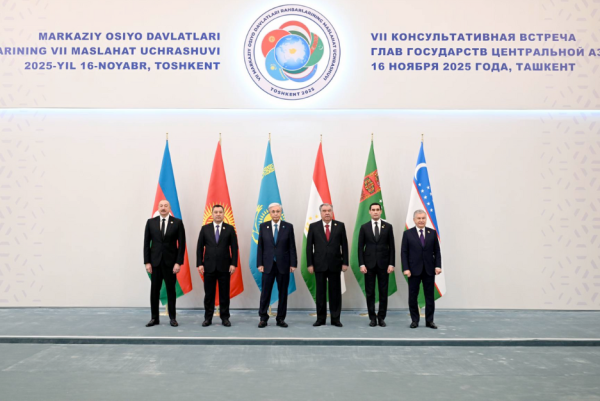
On November 15, Azerbaijan formally joined the Central Asian Consultative Meetings, expanding what was known as the Central Asian Five (C5) into a Central Asian Six (C6). Many in Central Asia find it surprising. But when viewed through the lens of recent geopo...

Gulkhanim Mammadova, 1 December 2025

Expert opinion

Azerbaijan joins the C5: implications for Eurasian regional architecture

When the long-standing C5 format of Central Asian cooperation formally expanded into a C6 on 15 November in Tashkent, Azerbaijan’s accession was framed as a natural extension of historical and linguistic affinities. Yet behind the rhetoric lies a structural tr...

Gulkhanim Mammadova, 21 November 2025

Expert opinion

Kazakhstan joins the Abraham Accords: Pragmatism or Symbolism?

Kazakhstan’s accession to the Abraham Accords—anticipated in some political circles—may still raise eyebrows. Unlike the original signatories, who were establishing relations with Israel from scratch, Kazakhstan has long maintained cordial ties with the Jewish...

Rusif Huseynov, 9 November 2025

Expert opinion

13 June attack: quick comments

In the most extensive attack on Iran since the country’s 1980-88 war with Iraq, Israeli forces have launched multiple waves of nationwide bombings. The attack is ongoing and believed to be the opening shots of a wider campaign to degrade Iran’s military comman...

Murad Muradov, 13 June 2025

Expert opinion

Historic First in Tbilisi: Armenia, Azerbaijan and Georgia trilateral talks

On April 17, Tbilisi hosted the first-ever formal trilateral meeting between the foreign ministries of Armenia, Azerbaijan and Georgia. According to official statements, the primary aim of the meeting was to create a platform for open dialogue and to explore p...

Gulkhanim Mammadova, 17 April 2025

Expert opinion

Munich speech, 18 years later

The Munich speech of the U.S. Vice President J. D. Vance will definitely enter the textbooks of the future as one of the harbingers of a new historic period. This speech has been arguably more shocking than Vladimir Putin’s diatribe he made on the same stage 1...

Murad Muradov, 19 February 2025