

Topchubashov Center
Expert opinion 2 min read

Why Israel has the highest Covid-19 vaccination rate in the world

Why Israel has the highest Covid-19 vaccination rate in the world
Toms Rātfelders Expert Published

Listen to this article Read by an AI voice

Israel currently leads the world in vaccination rate per capita. According to the official statistics, Israel administers 30.14 doses per 100 people in the total population (this is counted as a single dose and may not equal the number of people vaccinated). If the vaccination continues at such a rate, Israel might as well become the first country in the world to achieve herd immunity. There are even cautious hopes that this might happen already by March.

There are multiple reasons for this phenomenon. First of all, Israel has capitalized on the already existing high-tech healthcare infrastructure. People can simply receive a text message from one of the health maintenance organizations with the necessary instructions to receive a vaccine. After receiving the first dosage, the second one is usually administered at the same time and place after three weeks. The infrastructure also provides useful tools for tracking vaccinated and unvaccinated parts of the population in addition to monitoring after-effects. 

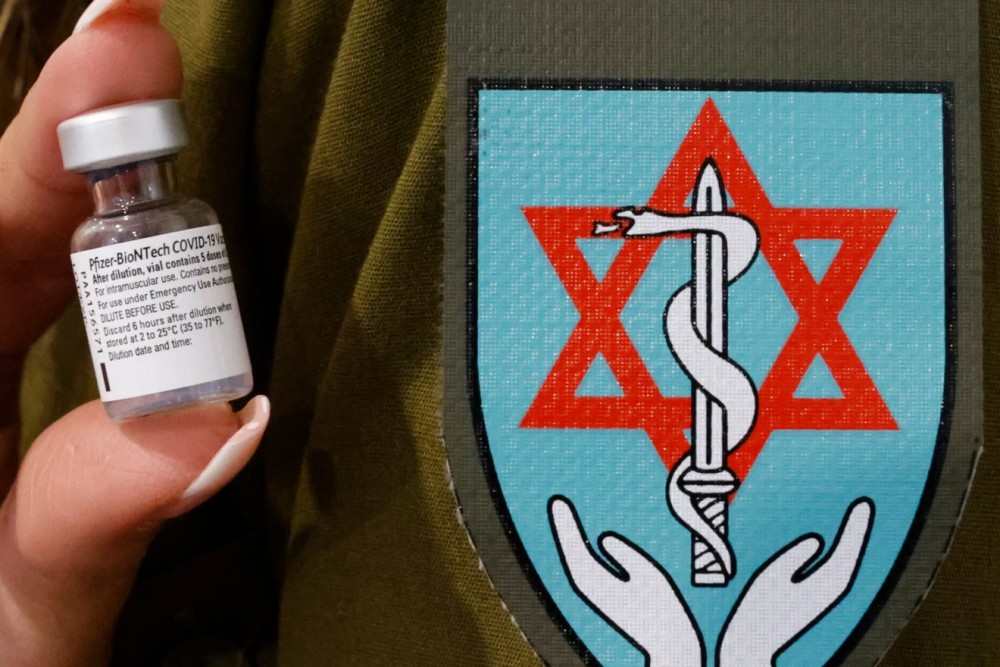
The second reason is largely connected to the efficiency and flexibility of its approach to vaccination. Israel has provided the opportunity to receive leftover doses for people not included in the defined priority groups. Respectively, everyone has a chance to show up at local immunization centers without a previous appointment and hope to snag a vaccine otherwise poised for spoiling and being tossed out. Moreover, Israel has given the green light to healthcare providers to extract additional doses of vaccine from a single vial. It is important since the U.S. Food and Drug Administration has confirmed that some vials of Pfizer/BioNtech vaccine are overfilled and contain enough doses for up to seven people (instead of five).

The third reason is the superb logistical support in addition to geographic and demographic advantages. Israel has managed to transform many public places – cinemas, stadiums, theaters, cultural centers, and others into vaccination sites. Moreover, the relatively large population density means that people do not have to travel long distances to receive their shot. The relatively small population size also helps. 

The most important reason, however, might as well be connected to the mentality of the people of Israel. It is necessary to understand that Israel has been used to exist in the state of crisis constantly, and the Covid-19 pandemic is just another challenge to tackle. In this situation, Israelis have once again shown their willingness to mobilize when necessary – as has been done many times in the past. It also seems that Israelis are keen on trusting the opinions of scientists and leading experts. This might be one of the reasons why disinformation and conspiracy theories, although strong in Israel, have not prevailed in the end.

 

Related work

Expert opinion

US foreign policy before midterm election

As the US midterm election is approaching, the correlation between President Trump’s statements and actual US policies, gets more and more uncertain. And while his occasional eccentricities on Twitter or during rallies with supporters, have become part of a po...

Murad Muradov, 27 October 2026

Expert opinion

Connecting Central Asia and the South Caucasus

On November 15, Azerbaijan formally joined the Central Asian Consultative Meetings, expanding what was known as the Central Asian Five (C5) into a Central Asian Six (C6). Many in Central Asia find it surprising. But when viewed through the lens of recent geopo...

Gulkhanim Mammadova, 1 December 2025

Expert opinion

Azerbaijan joins the C5: implications for Eurasian regional architecture

When the long-standing C5 format of Central Asian cooperation formally expanded into a C6 on 15 November in Tashkent, Azerbaijan’s accession was framed as a natural extension of historical and linguistic affinities. Yet behind the rhetoric lies a structural tr...

Gulkhanim Mammadova, 21 November 2025

Expert opinion

Kazakhstan joins the Abraham Accords: Pragmatism or Symbolism?

Kazakhstan’s accession to the Abraham Accords—anticipated in some political circles—may still raise eyebrows. Unlike the original signatories, who were establishing relations with Israel from scratch, Kazakhstan has long maintained cordial ties with the Jewish...

Rusif Huseynov, 9 November 2025

Expert opinion

13 June attack: quick comments

In the most extensive attack on Iran since the country’s 1980-88 war with Iraq, Israeli forces have launched multiple waves of nationwide bombings. The attack is ongoing and believed to be the opening shots of a wider campaign to degrade Iran’s military comman...

Murad Muradov, 13 June 2025

Expert opinion

Historic First in Tbilisi: Armenia, Azerbaijan and Georgia trilateral talks

On April 17, Tbilisi hosted the first-ever formal trilateral meeting between the foreign ministries of Armenia, Azerbaijan and Georgia. According to official statements, the primary aim of the meeting was to create a platform for open dialogue and to explore p...

Gulkhanim Mammadova, 17 April 2025

Expert opinion

Munich speech, 18 years later

The Munich speech of the U.S. Vice President J. D. Vance will definitely enter the textbooks of the future as one of the harbingers of a new historic period. This speech has been arguably more shocking than Vladimir Putin’s diatribe he made on the same stage 1...

Murad Muradov, 19 February 2025