

Topchubashov Center
Expert opinion 2 min read

Urban terrorism: Why Armenia targets cities

Urban terrorism: Why Armenia targets cities
Anar Valiyev Expert Published

Listen to this article Read by an AI voice

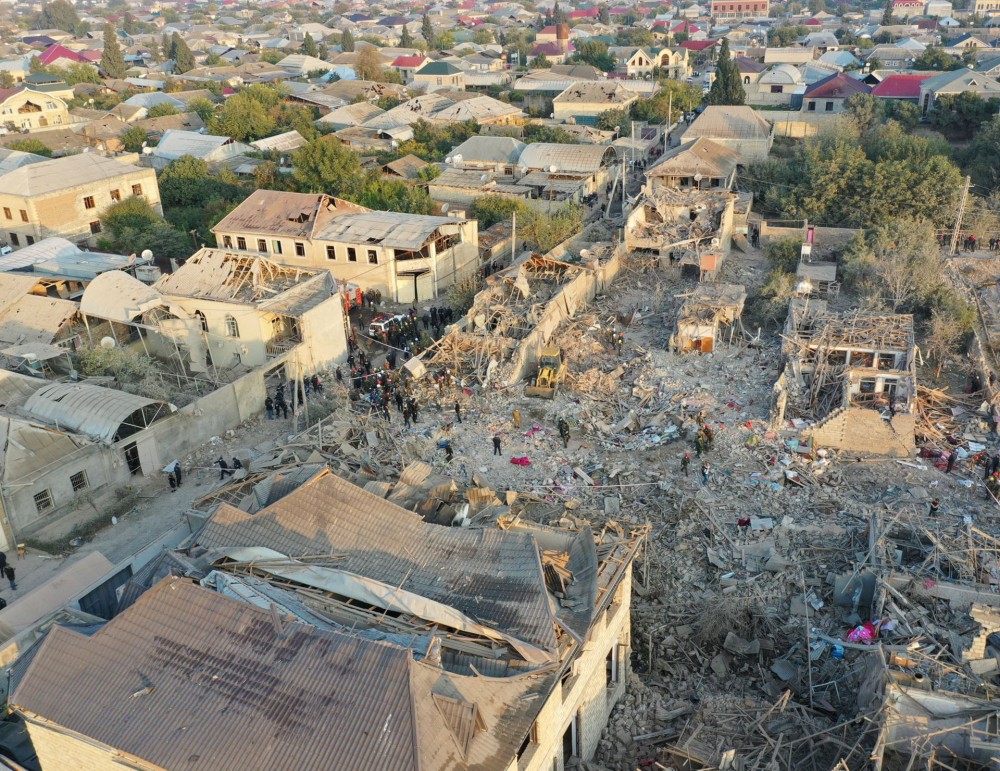
Since the escalation of Karabakh conflict on September 27, 2020, Azerbaijan`s cities Terter, Barda, Agjabadi, Beylagan, Ganja and others have become targets of separatist Armenian warlords. Although some scholars usually qualify such kind of acts as war crimes, we would consider it as cases of urban terrorism.  According to UNODC, terrorism is defined as all criminal acts directed against a State and intended or calculated to create a state of terror in the minds of particular persons or a group of persons or the general public. In case the target is located within the city and has no military nature, it is defined as urban terrorism. What is the reason for Armenian attack on cities then? 

When Karabakh-based separatist warlords attack Ganja or Baku they do not necessarily try to hit the government or intend to inflict the casualties. Their main purpose is to attack the essence of cities and tend to destroy urban tolerance. Warlords hit Ganja because of what it symbolizes: Azerbaijani culture, identity, history and symbol of resistance. These cities are not only dense agglomerations of people and buildings, but also the guardians of national prestige and assets. By attacking urban areas, terrorists do not intend to take only the lives of the inhabitants, but also affect the life of an independent organism, city. The change in life of the city affects the citizens much more than that short-term shock aftermath of an attack.

There are at least five terrorist strategies that common in actions of Armenian separatists or any other terrorist organizations. These strategies often used in cities aim to 1) create a sense of social dislocation; 2) spread fear, anarchy and chaos; 3) discredit existing governments in order to deliberately provoke sense of vulnerability; 4) generate economic and military damage; 5) to internationalize a cause or gain publicity. 

So, what makes cities highly prized targets for warlords? Cities serve as nerve centers for domestic economy. The larger the city and the more significant its role in the world affairs, the more attractive it is for terrorists to attack. The city’s role as a nerve hub, its visibility and capacity to dramatize attacks, make it an ideal spot from which to broadcast the terrorist message. Meanwhile, terrorists generally choose targets that have symbolic value or that will evoke the greatest media attention, and have psychological effect. Therefore, cities having higher numbers of symbolic targets as well as cities with high media attention will have higher chances of attracting terrorists. 

 

Related work

Expert opinion

US foreign policy before midterm election

As the US midterm election is approaching, the correlation between President Trump’s statements and actual US policies, gets more and more uncertain. And while his occasional eccentricities on Twitter or during rallies with supporters, have become part of a po...

Murad Muradov, 27 October 2026

Expert opinion

Connecting Central Asia and the South Caucasus

On November 15, Azerbaijan formally joined the Central Asian Consultative Meetings, expanding what was known as the Central Asian Five (C5) into a Central Asian Six (C6). Many in Central Asia find it surprising. But when viewed through the lens of recent geopo...

Gulkhanim Mammadova, 1 December 2025

Expert opinion

Azerbaijan joins the C5: implications for Eurasian regional architecture

When the long-standing C5 format of Central Asian cooperation formally expanded into a C6 on 15 November in Tashkent, Azerbaijan’s accession was framed as a natural extension of historical and linguistic affinities. Yet behind the rhetoric lies a structural tr...

Gulkhanim Mammadova, 21 November 2025

Expert opinion

Kazakhstan joins the Abraham Accords: Pragmatism or Symbolism?

Kazakhstan’s accession to the Abraham Accords—anticipated in some political circles—may still raise eyebrows. Unlike the original signatories, who were establishing relations with Israel from scratch, Kazakhstan has long maintained cordial ties with the Jewish...

Rusif Huseynov, 9 November 2025

Expert opinion

13 June attack: quick comments

In the most extensive attack on Iran since the country’s 1980-88 war with Iraq, Israeli forces have launched multiple waves of nationwide bombings. The attack is ongoing and believed to be the opening shots of a wider campaign to degrade Iran’s military comman...

Murad Muradov, 13 June 2025

Expert opinion

Historic First in Tbilisi: Armenia, Azerbaijan and Georgia trilateral talks

On April 17, Tbilisi hosted the first-ever formal trilateral meeting between the foreign ministries of Armenia, Azerbaijan and Georgia. According to official statements, the primary aim of the meeting was to create a platform for open dialogue and to explore p...

Gulkhanim Mammadova, 17 April 2025

Expert opinion

Munich speech, 18 years later

The Munich speech of the U.S. Vice President J. D. Vance will definitely enter the textbooks of the future as one of the harbingers of a new historic period. This speech has been arguably more shocking than Vladimir Putin’s diatribe he made on the same stage 1...

Murad Muradov, 19 February 2025