


Topchubashov Center
Expert opinion 2 min read

Amid Russian-Ukrainian crisis, Italy and Azerbaijan increase energy cooperation

Amid Russian-Ukrainian crisis, Italy and Azerbaijan increase energy cooperation
Simona Scotti Research Fellow Published

Listen to this article Read by an AI voice

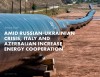
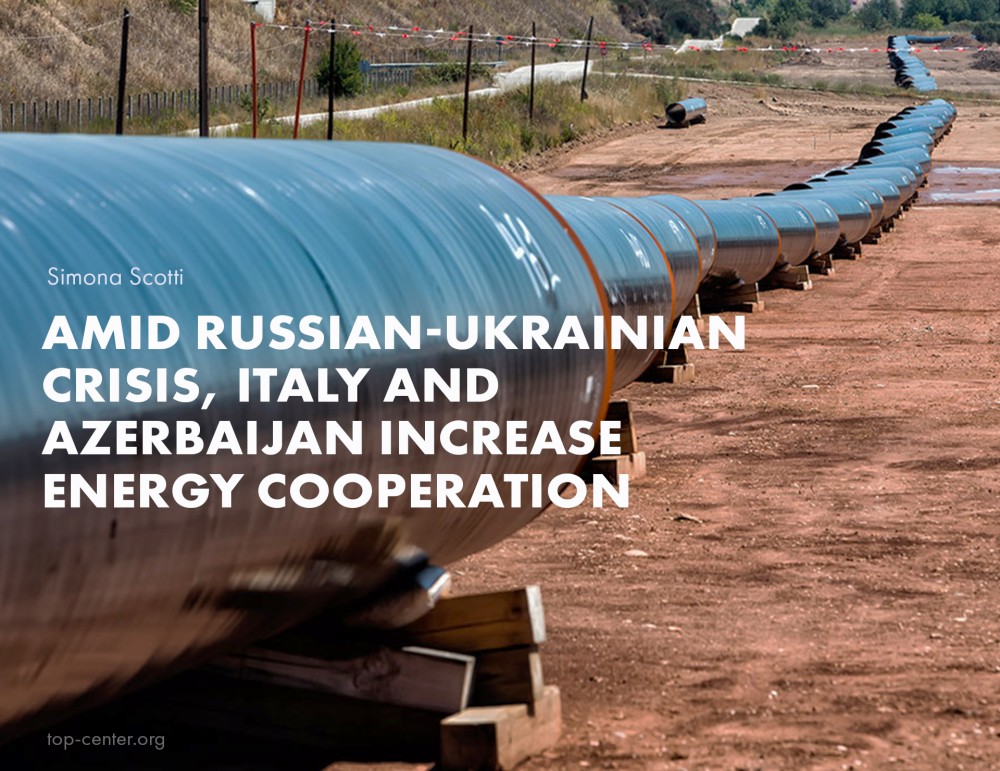
The global increase in energy prices in the post-pandemic phase has pushed all states to strengthen their supply chains. Furthermore, since the beginning of 2022, Moscow has almost halved the flows of gas destined for Europe via the Ukrainian route. This poses a considerable risk to European energy security. In this respect, Italy has the chance to exploit its privileged relations with Baku to increase the supply of natural gas from the Caspian through the Trans Adriatic Pipeline (TAP), a natural gas infrastructure that strategically delivers Azerbaijani gas from the Shah Deniz offshore field in the Caspian Sea to Southern Italy.

On February 1, the Italian Undersecretary for Foreign Affairs Manlio Di Stefano had a telephone conversation with the Azerbaijani Energy Minister Parviz Shahbazov. The purpose of the call was to bring the Trans Adriatic Pipeline (TAP), currently operating at 80%, to maximum capacity. Minister Shahbazov has agreed to increase gas supplies to Italy, on condition that there is a clear commitment from Rome to purchase it over the medium to long term. In this regard, Undersecretary Di Stefano confirmed that a market test would be underway to probe the willingness of Italian companies to work with Azerbaijani gas. Later, in an interview with the Italian newspaper La Repubblica, Di Stefano stated that Italy's intention is to bring TAP gas flows from 7 to 10 billion cubic meters in order to further diversify its supplies and reduce Italy’s dependence on Russia.

Italy imports more than 95% of the energy it consumes. This last month, gas bills in Italy have skyrocketed, with substantial damage for many families. This makes Italy's need for reliable energy suppliers even more evident. In this regard, the traditionally strong relations between Baku and Rome constitute a safe stronghold for Italy, because Azerbaijan is able to provide competitive and affordable gas supplies to its deprived energy markets. Indeed, it is thanks to TAP if the increasingly high gas bills will be mitigated.

The Russian-Ukrainian crisis and the further Russian estrangement from the West naturally strengthen the partnership between Azerbaijan and Italy, and turn Azerbaijan into a strategic country for the entire European Union. The restrictive geopolitical environment thus makes Azerbaijan more and more fundamental in the European energy supply diversification strategy. Moreover, natural gas is a key element in enabling the decarbonization and the energy transition that the European countries are implementing. Therefore, closer cooperation between Azerbaijan and the West on energy issues is to be expected in the near future.

Related work

Expert opinion

US foreign policy before midterm election

As the US midterm election is approaching, the correlation between President Trump’s statements and actual US policies, gets more and more uncertain. And while his occasional eccentricities on Twitter or during rallies with supporters, have become part of a po...

Murad Muradov, 27 October 2026

Expert opinion

Connecting Central Asia and the South Caucasus

On November 15, Azerbaijan formally joined the Central Asian Consultative Meetings, expanding what was known as the Central Asian Five (C5) into a Central Asian Six (C6). Many in Central Asia find it surprising. But when viewed through the lens of recent geopo...

Gulkhanim Mammadova, 1 December 2025

Expert opinion

Azerbaijan joins the C5: implications for Eurasian regional architecture

When the long-standing C5 format of Central Asian cooperation formally expanded into a C6 on 15 November in Tashkent, Azerbaijan’s accession was framed as a natural extension of historical and linguistic affinities. Yet behind the rhetoric lies a structural tr...

Gulkhanim Mammadova, 21 November 2025

Expert opinion

Kazakhstan joins the Abraham Accords: Pragmatism or Symbolism?

Kazakhstan’s accession to the Abraham Accords—anticipated in some political circles—may still raise eyebrows. Unlike the original signatories, who were establishing relations with Israel from scratch, Kazakhstan has long maintained cordial ties with the Jewish...

Rusif Huseynov, 9 November 2025

Expert opinion

13 June attack: quick comments

In the most extensive attack on Iran since the country’s 1980-88 war with Iraq, Israeli forces have launched multiple waves of nationwide bombings. The attack is ongoing and believed to be the opening shots of a wider campaign to degrade Iran’s military comman...

Murad Muradov, 13 June 2025

Expert opinion

Historic First in Tbilisi: Armenia, Azerbaijan and Georgia trilateral talks

On April 17, Tbilisi hosted the first-ever formal trilateral meeting between the foreign ministries of Armenia, Azerbaijan and Georgia. According to official statements, the primary aim of the meeting was to create a platform for open dialogue and to explore p...

Gulkhanim Mammadova, 17 April 2025

Expert opinion

Munich speech, 18 years later

The Munich speech of the U.S. Vice President J. D. Vance will definitely enter the textbooks of the future as one of the harbingers of a new historic period. This speech has been arguably more shocking than Vladimir Putin’s diatribe he made on the same stage 1...

Murad Muradov, 19 February 2025