

Topchubashov Center
Expert opinion 2 min read

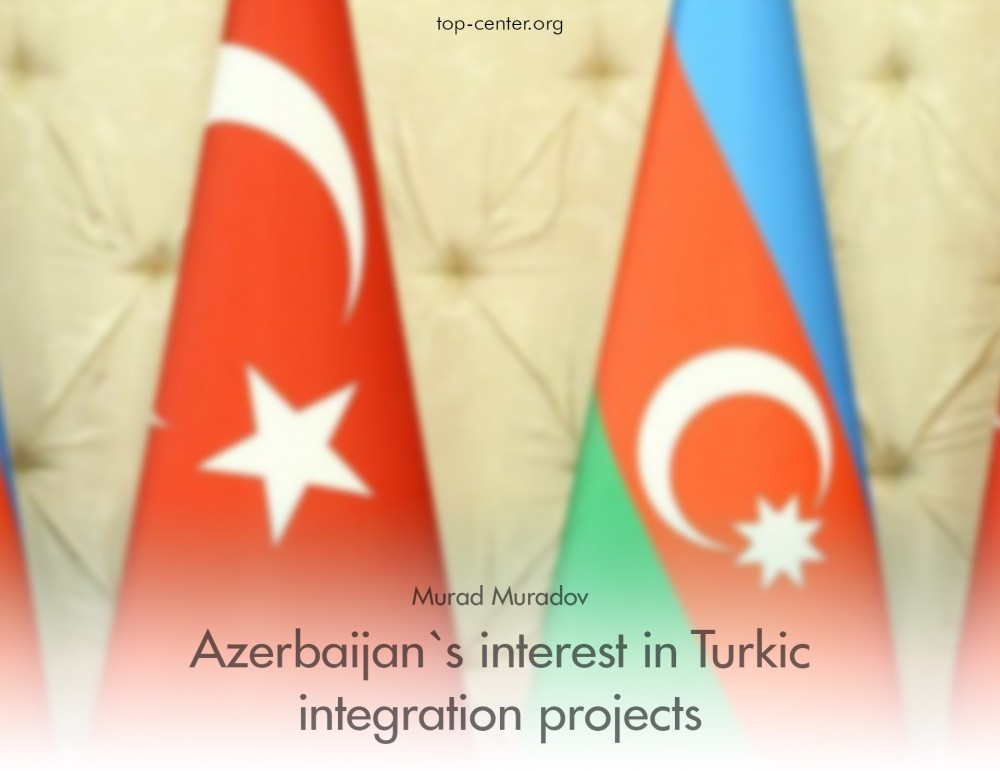
Azerbaijan`s interest in Turkic integration projects

Azerbaijan`s interest in Turkic integration projects
Murad Muradov Co-founder, Deputy Director Published

Listen to this article Read by an AI voice

Azerbaijan's interests in the Organization of the Turkic countries should be considered in three aspects. 

Firstly, symbolic, and ideological. Azerbaijan gained independence in the wake of the growth of national consciousness, awareness of its Turkic roots and the desire to reunite with brothers of origin from other countries. Therefore, for Baku, the organization TURKSOY, later the Turkic Council, has always been important for self-identification in the global world and strengthening both its own state ideology and legitimacy, and the promotion of soft power abroad.

The second aspect is political and strategic. Azerbaijan has a middle position both geographically and historically, as well as culturally between Turkey and the Central Asian country and perceives itself as a certain bridge in the Turkic world. This position is an important link between Europe and Asia, a crossroads of various transport routes. It is of significance that the Karabakh conflict had been the number one issue in Baku's foreign policy strategy for a long time. After the defeat in 1994, Azerbaijan began to strengthen its international status and role step by step, using various configurations and associations of countries. Positioning herself as a Muslim and secular, European, Turkic, Eastern and post-Soviet country, Azerbaijan feels “at home” in very different “companies” and integration associations. Unconditional support of its position among the Turkic countries, two of which are also members of the CSTO along with Armenia, is very vital for Baku in this regard.

Thirdly, the Turkic countries are very important for Azerbaijan from an economic point of view. On the one hand, Turkey is invariably one of the main trade and investment partners. On the other hand, it is the Turkic countries of Central Asia - Kazakhstan, Uzbekistan, Kyrgyzstan, and now Turkmenistan - that have the potential to create economic synergies that could potentially seriously spur the development of large international connectivity projects, as well as infrastructure facilities – a port and a free economic zone in Alat and the Baku-Tbilisi-Kars railway, in which Baku has invested billions of dollars. Strengthening economic relations with the Central Asian Republics through the creation of a common Turkic platform is the most promising way for Azerbaijan to expand regional significance and, accordingly, dividends from these projects.

 

Related work

Expert opinion

US foreign policy before midterm election

As the US midterm election is approaching, the correlation between President Trump’s statements and actual US policies, gets more and more uncertain. And while his occasional eccentricities on Twitter or during rallies with supporters, have become part of a po...

Murad Muradov, 27 October 2026

Expert opinion

Connecting Central Asia and the South Caucasus

On November 15, Azerbaijan formally joined the Central Asian Consultative Meetings, expanding what was known as the Central Asian Five (C5) into a Central Asian Six (C6). Many in Central Asia find it surprising. But when viewed through the lens of recent geopo...

Gulkhanim Mammadova, 1 December 2025

Expert opinion

Azerbaijan joins the C5: implications for Eurasian regional architecture

When the long-standing C5 format of Central Asian cooperation formally expanded into a C6 on 15 November in Tashkent, Azerbaijan’s accession was framed as a natural extension of historical and linguistic affinities. Yet behind the rhetoric lies a structural tr...

Gulkhanim Mammadova, 21 November 2025

Expert opinion

Kazakhstan joins the Abraham Accords: Pragmatism or Symbolism?

Kazakhstan’s accession to the Abraham Accords—anticipated in some political circles—may still raise eyebrows. Unlike the original signatories, who were establishing relations with Israel from scratch, Kazakhstan has long maintained cordial ties with the Jewish...

Rusif Huseynov, 9 November 2025

Expert opinion

13 June attack: quick comments

In the most extensive attack on Iran since the country’s 1980-88 war with Iraq, Israeli forces have launched multiple waves of nationwide bombings. The attack is ongoing and believed to be the opening shots of a wider campaign to degrade Iran’s military comman...

Murad Muradov, 13 June 2025

Expert opinion

Historic First in Tbilisi: Armenia, Azerbaijan and Georgia trilateral talks

On April 17, Tbilisi hosted the first-ever formal trilateral meeting between the foreign ministries of Armenia, Azerbaijan and Georgia. According to official statements, the primary aim of the meeting was to create a platform for open dialogue and to explore p...

Gulkhanim Mammadova, 17 April 2025

Expert opinion

Munich speech, 18 years later

The Munich speech of the U.S. Vice President J. D. Vance will definitely enter the textbooks of the future as one of the harbingers of a new historic period. This speech has been arguably more shocking than Vladimir Putin’s diatribe he made on the same stage 1...

Murad Muradov, 19 February 2025