

Armenia's fateful elections
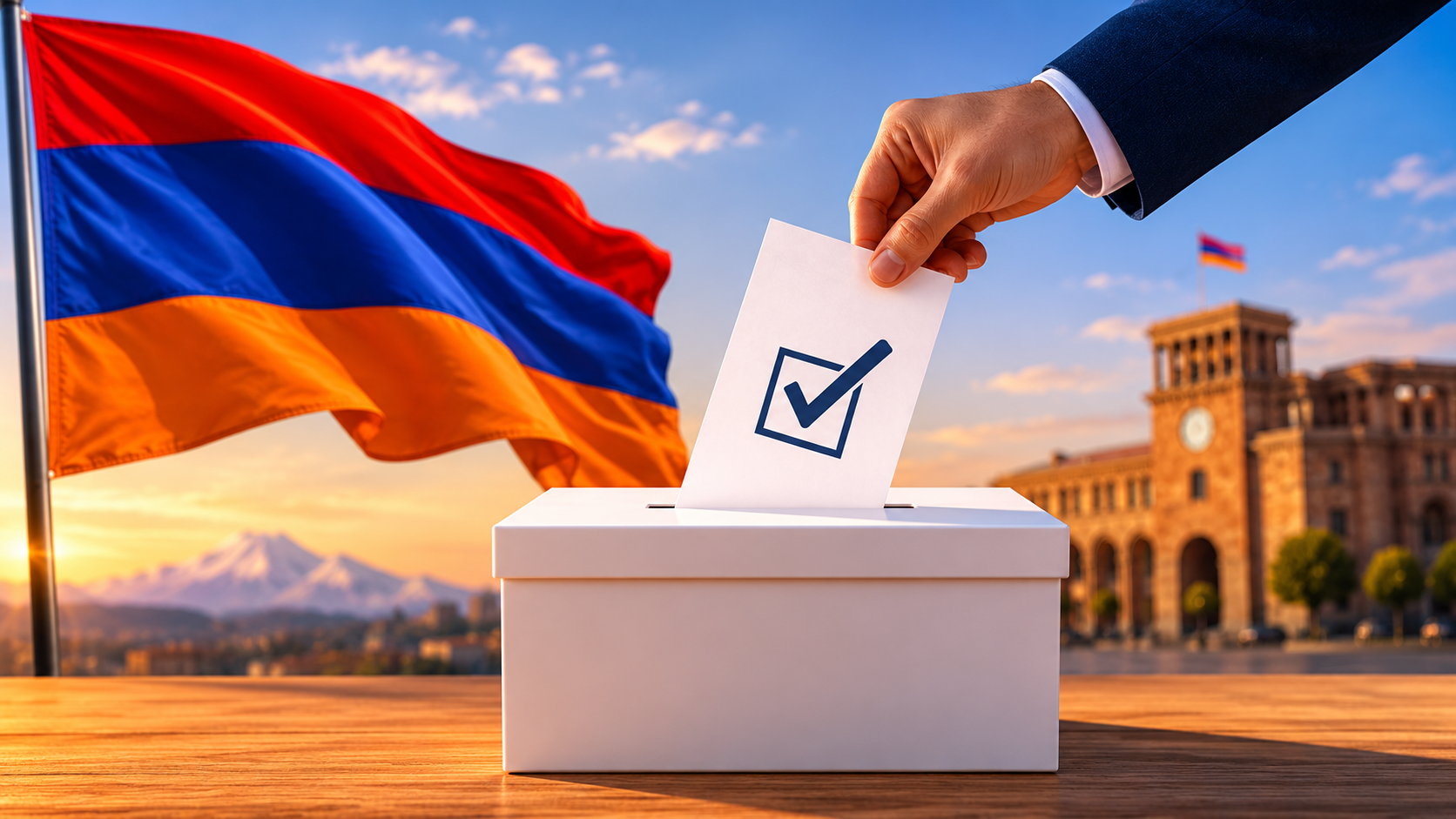
It is not very often that formal elections happen to be a milestone signifying transition from one sociopolitical reality into another. The upcoming Armenian voting which will be cast on June 7, will likely be one of those moments.
It comes at the time when the South Caucasian republic, for the first time in its independent history, lives in the situation of a de-facto peace with Azerbaijan, and its government has been exceptionally enthusiastic about pursuing a wider reconciliation process that would involve a full-fledged diplomatic and economic opening, and aim at a general societal normalisation.
The ruling “Civic movement” party, led by the Prime Minister Nikol Pashinyan, has had a tumultuous five-year term. In 2021, it managed to snatch a victory amid a severe post-war depression, when Pashinyan was widely accused of treason, so broadly that many Armenian citizens preferred to stay silent about their support. Back then, the “Civil contract” ran a very different programme, promising the electorate to fight for the international recognition of the so-called “Republic of Artsakh” based on the principle of “remedial secession”, earlier applied in the case of Kosovo- back then, Russian peacekeepers were deployed in Azerbaijan, and the war in Ukraine hadn’t even started. It was Armenia at a historic dead-end, and Pashinyan was torn between the realisation of the irreversible loss to Azerbaijan that had already happened, and the need to preserve his image as an acceptable national leader by appealing to the popular sentiment.
Since then, the Armenian government withstood the military crises of September 2022 and September 2023, recognised Azerbaijani territorial integrity, and entered tedious negotiations with Azerbaijan which finally brought the parties to agree on a peace treaty text in March 2025 and initial it on August 8 in Washington. At some point, Baku and Yerevan switched to a bilateral negotiation format without any third-party mediation, which, contrary to all expectations, proved to be very efficient. Since October last year, Azerbaijan has been pursuing a step-by-step economic opening, initially providing its territory for the transit of essential goods to Armenia, and later starting to export its own petrol. The long-time rivals have intensified their contacts in several formats, and the mutual rhetoric has been growing remarkably positive.
To prepare the Armenian society, used to function and think in the conflict-determined paradigm, Pashinyan launched a cognitive revolution, calling for replacing “historic Armenia”- an identity defined by longing for the loss grandeur, with “real Armenia”, a country at peace with its present situation and de-jure borders.
This message, deliberately provocative and polarising, was meant to instill the understanding of irreversibility of change and convince the people that it is an ultimate blessing for the country’s security and development. Instead, the government focused on more robust and inclusive economic growth, strengthening the rule of law and democratic norms. While the “Civil contract” faced significant discontent along the way, most notably accumulated in the movement led by the priest Bagrat Galstanyan in 2024, no significant setbacks happened. So, Pashinyan views the upcoming election as the moment of truth when the vote for his party would serve as a decisive national statement in favour of peace and “real Armenia”, as he views it.
However, these elections also turned Armenia into a node of geopolitical tension.
Russia, Yerevan’s traditional security patron, has been rapidly losing its influence in the South Caucasus, and it perceives the end of the Karabakh conflict as the loss of its crucial leverage over this region.
Moscow was widely blamed in Armenia for not coming to help in the 44-day war and during the later skirmishes, and the Armenian public called to reconsider existing security commitments. Russian presence on the Armenian borders has already been decreasing, and Moscow fears that after the signing and ratification of the peace treaty Yerevan will double down its efforts on pushing Russian forces out of the country. As the peace talks between Baku and Yerevan were reaching the culmination point in mid-2025, Moscow, in a sign of unprecedented shift, became significantly more hostile towards both republics. President Putin and other senior Russian officials on a number of occasions hinted that the “loss of Karabakh” was due to Pashinyan’s recognition of Azerbaijan’s territorial integrity, probably sending a message that Moscow would have endorsed occupation if another government had been in power.
In 2025, Samvel Karapetyan, a Russian oligarch of Armenian origin whose company until recently owned the country’s electricity grid, moved to Armenia and established a political movement called “Strong Armenia”, aiming to become the major opposition force. The Kremlin was considered to be directly behind his figure. In response, the Armenian government pushed for nationalisation of Karapetyan’s company, and he was soon arrested for making public calls to seize power. However, the oligarch remained a key figure in the opposition camp, with former President Kocharyan’s “Armenia” bloc and “Prosperous Armenia” led by another oligarch Gagik Tsarukyan, being the major alternatives. All these three parties have criticized the ruling government for “spoiling relations with Russia” and accepting “unfavourable” and “humiliating” peace treaty terms.
Although each of them goes to elections independently, the three parties are expected to bundle their vote afterwards, and establish a single oppositional bloc.
Pro-government media and experts openly call Karapetyan, Kocharyan and Tsarukyan “Russian opposition” and the “three-headed dragon”, and recently a number of legal cases have been opened against their candidates for the alleged attempts to bribe voters and even outright spying, in case of Andranik Tevanyan, the number two on the Prosperous Armenia’s list.
At the same time, the West and Turkiye have thrown their support behind the incumbent government.
In January 2025, US signed a strategic partnership declaration with Armenia, while the Washington memorandum from August 8 brought the Trump administration into the equation as US pledged to build the future route connecting Azerbaijan and Armenia, eventually named TRIPP after the 47th US President. A few days ago, Secretary of State Marco Rubio landed in Yerevan to initiate an agreement on TRIPP and sign two other documents, in another gesture of support to the ruling government.
Yerevan has been also deepening its ties with the EU: in December, the two parties endorsed the Strategic Agenda for Partnership, while the Armenian government started to declare its ambitions for eventually obtaining an EU membership. While this is hardly a near prospect, the Civil Movement views the European integration agenda as an important tool to signal long-term development priorities and offer an attractive alternative that would legitimise the concept of “Real Armenia” and renunciation of any claims against Azerbaijan and Türkiye.
In May, European leaders gathering in Yerevan for the European Political Community summit, expressed unprecedented support to Pashinyan, while the state visit of French President Macron, lasting for three days, cemented the status of Armenia in European politics.
For obvious reasons, Baku and Ankara partake in this momentum and are strongly interested in a decisive victory of the incumbent government.
As to Pashinyan himself, he never intended to enforce a rupture with Moscow, given strong multifaceted links the countries have. However, Russia’s increasingly hostile stance towards him may prompt the Prime Minister to change his mind. At the April 1 meeting in Moscow, President Putin publicly advised Pashinyan to allow the participation of “pro-Russian candidates” in the elections, de-facto confirming his support of the opposition. Later on, the pressure intensified; Russian officials and state media started to castigate Armenia’s “Russophobic” turn and warn it against “repeating the fate of Ukraine”. Moreover, the Kremlin reverted to its classic arsenal of economic sanctions, banning the import of Armenian mineral water, brandy, fish and certain kinds of fruit for alleged “phytosanitary violations”. The Chairman of State Duma Volodin threatened with more consequences if Yerevan decides to leave the Eurasian Union, including barriers to employment and natural gas export stoppages. Armenian media have also reported attempts to fly in thousands of Armenian citizens residing in Russia, for the election time in order to boost opposition vote.
These steps would most likely backfire.
Recent polls have shown growing support for the ruling party: while a couple of months ago a narrow victory for the Civil Contract was considered the most likely outcome, today its predicted outcome may climb up to 60-62%, making a constitutional majority in the Parliament within reach. Moscow’s attempts to discredit him are possibly too obvious and too late: the Armenian voters, even those critical of the government, seem to be irritated by such a reckless display of pressure.
Moreover, the opposition leaders have been put in an awkward position. They would have a hard time to justify Russia’s preventive actions, given that Yerevan had been carefully abstaining from openly anti-Russian gestures, and retain their reputation of ardent patriots they had been so carefully building up. Moreover, their almost exclusive focus on the loss to Azerbaijan and feelings of resentment is another vulnerability: they understand very well that any real challenge to Baku is out of the question now and will only worsen Armenia’s security and economic standing. Hence, Armenians face a prospect of getting the worst of both worlds in the unlikely case of opposition victory: lose the benefits of the peace process without getting any symbolic compensation.
That said, Armenia right now is strongly in the focus of regional attention.
Should Pashinyan’s Civil Contract stay in power, normalisation with Azerbaijan will most probably gather pace, and the vision of South Caucasus as a major logistical hub may take shape.
It is also unclear how Moscow will react: Yerevan has demonstrated that it has geopolitical alternatives, and a full-on confrontation with Armenia will just serve to undermine Russia’s remaining influence in this region and potentially gain additional problems regarding its connectivity with Iran and Türkiye. Tehran will be likely alarmed by the growing American influence along its southern border, although the Armenian government has shown sensitivities to the Iranian concerns, and in case Iran reaches some sort of deal with Washington, it won’t have any reasons to escalate here. On the contrary, opposition, if it somehow manages to form the government or at least to have enough influence to put obstacles to Pashinyan’s government, would face a mammoth task of having to deliver on its national pride-related promises and stay within Russian orbit without provoking further ordeals for the country.