

Two Capitals, One Paymaster: The PUK Walkout and the Quiet Recentralisation of Iraqi Kurdistan
Abbreviations: KDP – Kurdistan Democratic Party; KRG – Kurdistan Regional Government; PUK – Patriotic Union of Kurdistan; SOMO – State Organization for Marketing of Oil
Bafel Talabani's withdrawal from the Kurdistan Regional Government is being read as a return to the Erbil–Sulaymaniyah duality of the 1990s. The analogy misleads.In the 1990s the two ruling parties carved up a region that Baghdad had stopped governing; in 2026 they are quarrelling over one that Baghdad pays for. The likelier scenario is a different one. Increasingly, the final word on Kurdish politics will belong to Baghdad rather than Erbil, while Tehran and Ankara shape the course of the process.
On 4 November 2026 the Kurdistan Parliament met for the first time since its inaugural sitting in December 2024. Fifty-two of its 100 deputies attended, one more than the quorum, and elected the Kurdistan Democratic Party's Vala Fareed as speaker. The quorum came from defectors. Six of them had been elected on the lists of the Patriotic Union of Kurdistan (PUK) and its ally, the New Generation Movement, three from each, and two more came from the National Stance (Halwest) movement and were expelled for it. Under an earlier understanding between the two ruling parties, the speakership was to go to the PUK.
The next evening, after an emergency leadership council in Sulaymaniyah attended by Iraqi President Nizar Amedi, Bafel Talabani pulled the PUK out of what he called a failed caretaker cabinet. He refused to recognise the session, accused the KDP of buying deputies and set out a threat of symmetry: "whatever you do there, we will do here." PUK officials were told to stop reporting to their offices, and Deputy Prime Minister Qubad Talabani, the party leader's brother, convened the administrative units of Sulaymaniyah and Halabja.
In Erbil, Baghdad and Ankara the default analogy became the twin administrations of 1994–2005. After a civil war, the KDP ruled from Erbil and the PUK from Sulaymaniyah. Even Ashbetal, the Kurdish word for the broken mill of 1975, has resurfaced. The analogy is understandable, and it points policy toward the wrong danger.
The partition of the 1990s was possible because nobody was paying the Kurdistan Region. Each party financed itself from the customs posts, smuggling routes and UN relief it physically held, while Baghdad sat outside under an embargo and a no-fly zone. Today, public salaries in the Region depend on monthly transfers from the federal treasury. The money is routed through a single finance ministry in Erbil, under budget conditions that Baghdad writes and the Federal Supreme Court polices.
A party that walks out of that system cannot rebuild the order of 1996 in Sulaymaniyah. What it can do is change who adjudicates the Kurdish quarrel.
The most probable result of the PUK–KDP rupture appears to be a gradual conversion of the Kurdistan Region from a jointly owned constitutional entity into a contested estate that Baghdad arbitrates and its neighbours price.
This process can be best described as de facto federalisation by subtraction, which neither party exactly intends, but both are accelerating.
From Fifty-Fifty to Arithmetic
The Erbil–Sulaymaniyah divide is older than either party. Sulaymaniyah was founded in 1784 as the seat of the Baban emirate, while Erbil and the Badinan uplands looked toward Mosul and the Barzan network. In 1964 the KDP's politburo, Ibrahim Ahmad and Jalal Talabani, broke with Mustafa Barzani; Talabani founded the PUK in June 1975, after the Algiers Agreement ended Barzani's revolt. The first Kurdistan elections in May 1992 produced a near tie, which the parties turned into an equal division of the assembly and the cabinet. Quarrels over customs revenue at the Ibrahim Khalil crossing and over land led to war in 1994, and in 1996 the KDP called in Saddam Hussein's armour to retake Erbil. The 1998 Washington accord ended the fighting, the administrations merged in 2006, and the 2007 strategic agreement extended this fifty-fifty arrangement: Barzani took the regional presidency, Talabani the Iraqi presidency.
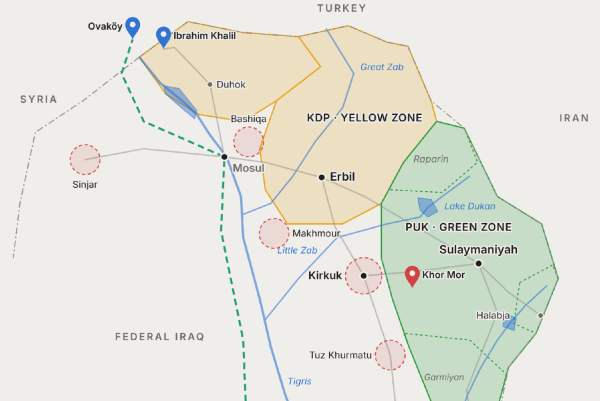
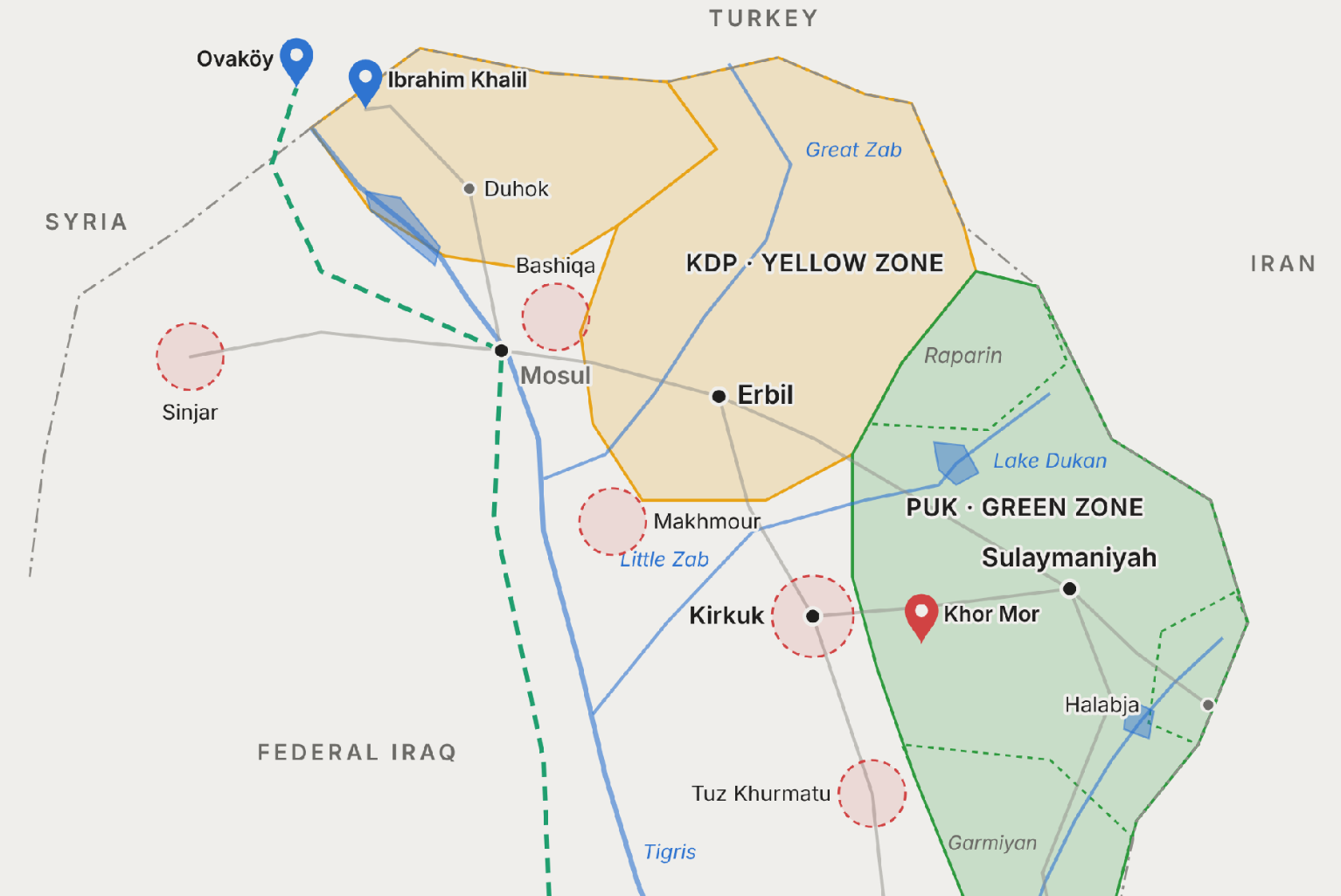
Formal unification left the security map intact. The KDP's forces still govern the so-called yellow zone of Erbil and Duhok, and the PUK's the green zone of Sulaymaniyah and Halabja. The Asayish, the intelligence services and, until September, the party-run Peshmerga Units 80 and 70 all follow that line.
Two decades of joint cabinets were a condominium laid over a partition that never ended.
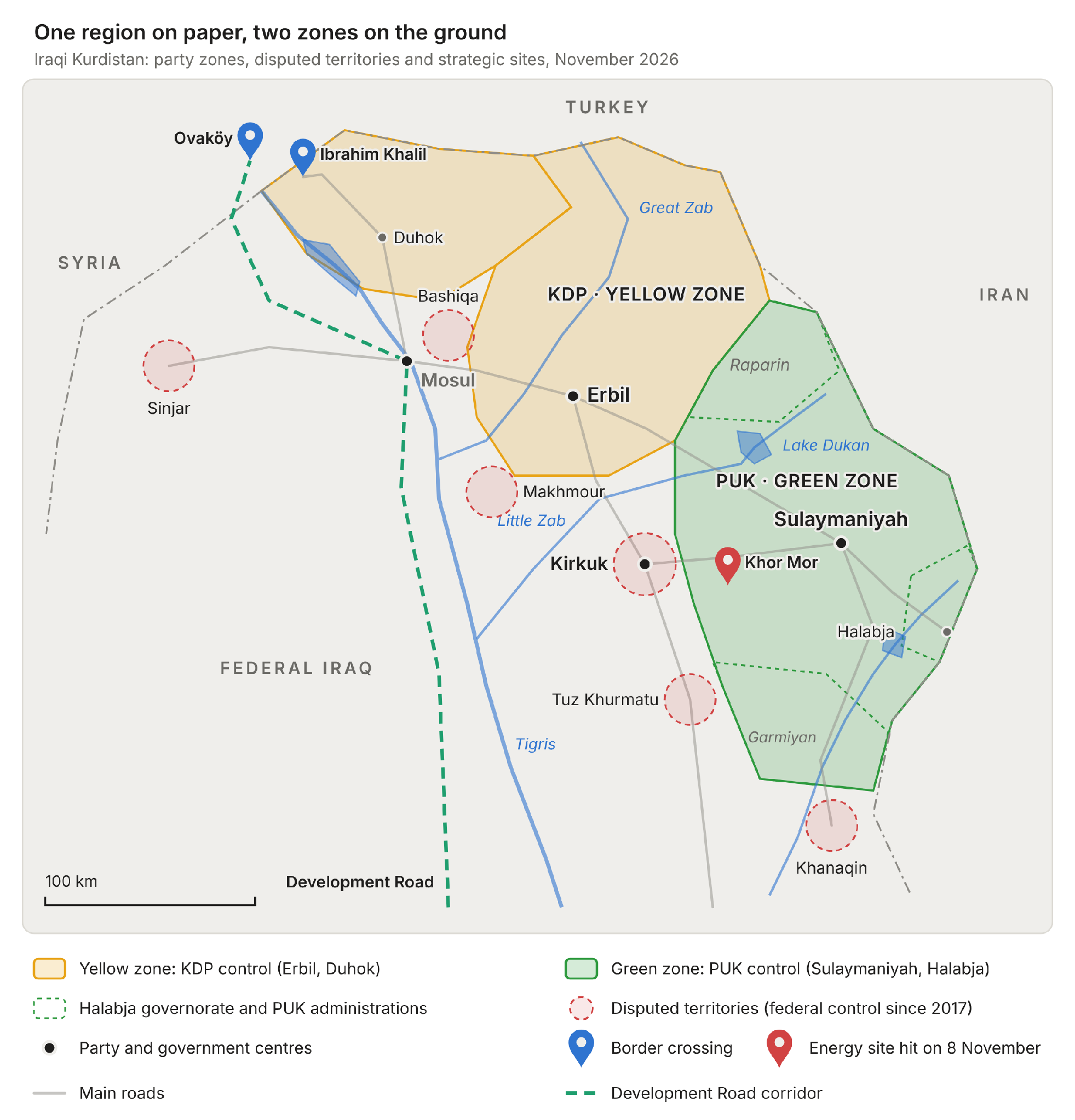
What changed after 2009 was the electoral balance underneath. Gorran split from the PUK and beat it in Sulaymaniyah in 2013. Jalal Talabani died in October 2017, days before Iraqi forces retook Kirkuk; a feud between Bafel and his cousin Lahur ended in armed clashes in August 2025 and a five-year sentence for Lahur in October 2026. The PUK fell to 23 seats against the KDP's 39 in October 2024, and in May 2025 Masoud Barzani declared the fifty-fifty era over. Baghdad, meanwhile, dismantled the Region's independent pillars one by one. The Federal Supreme Court struck down the Kurdistan oil and gas law in 2022, the Kirkuk–Ceyhan pipeline had stayed shut to Kurdish crude for some thirty months after a March 2023 arbitration ruling, further rulings removed the regional parliament's self-extended mandate, and Halabja became Iraq's nineteenth province in April 2025. Fifty-fifty had rested on rents that each party controlled at source. By 2026 most of those rents ran through Baghdad, and the formula was left defending a parity that the money no longer supported.
Two bargains are being struck at once. Inside the Region, the KDP and the PUK are renegotiating what an election entitles a party to. Around the Region, Baghdad, Tehran, Ankara and Washington are deciding how much of the Kurdish file they want to hold directly. The first bargain is loud; the second will decide the outcome.
KDP: The KDP's case is electoral. With 39 seats, the minority-quota deputies and a handful of defectors, it can reach 51 without the PUK. In the KDP's reading, the fifty-fifty formula has been overtaken by the results. The prize in dispute is the regional Interior Ministry, held by the KDP's Rebar Ahmed, which commands the Asayish and the Zeravani. The PUK has made that portfolio its central demand. The KDP also carries a grievance from April 2026, when the federal parliament elected the PUK's Nizar Amedi president of Iraq over a KDP boycott. Yet the KDP is hedging. Barzani's invitation to talks on 9 November, the party's public commitment not to form a cabinet without the PUK, and the KRG cabinet's call on 11 November for PUK ministers to return make the move calculated pressure with the door left open. The constraint is territorial: a KDP-only cabinet would govern up to the Erbil–Sulaymaniyah line and no further. Abroad, the Pentagon's FY2027 request cuts support for the Ministry of Peshmerga Affairs from $77 million to about $1.35 million, and the KDP has answered by building the UAE into an outside pole.
PUK: The PUK's 23 seats understate what it holds. Its security services, its former 70 Forces and its intelligence apparatus run the green zone of Sulaymaniyah, Halabja and Garmiyan, and it is the leading Kurdish force in Kirkuk. The walkout is coercive bargaining, meant to stop the KDP from steering government formation alone, and its threats escalate by stages: parallel appointments, a challenge before the Federal Supreme Court (filed jointly with New Generation on 10 November, seeking to annul the 4 November session), and, at the end of the ladder, an Article 119 petition for a separate region. Its foreign portfolio has turned over as well. The party historically closest to Tehran met Iranian Speaker Mohammad Baqer Qalibaf in September, while the PKK peace process turned its proximity to the PKK into an asset in Ankara. The PUK has no revenue of its own large enough to pay Sulaymaniyah's salaries, however.
Its parallel government would have offices and no payroll.
New Generation and the defectors. New Generation's 15 seats gave the PUK a 38-seat bloc, one short of the KDP. But the pact was built around a budget law, not a cabinet.
Baghdad: Prime Minister Ali al-Zaidi's government holds the cards that matter. The draft 2027 budget ties the Region's 12.67 percent share to at least 400,000 barrels a day delivered to SOMO. Erbil offers 250,000 to 280,000 barrels and demands 14.14 percent on the basis of the new census, and the cabinet vote has slipped to 14 November. PUK accusations of crude smuggled from the KDP zone supply Baghdad's case for posting SOMO staff at the fields. Zaidi's pledge on 3 November to pay Kurdish public employees on a par with other state workers tells Sulaymaniyah that salaries can reach it without Erbil's mediation. Every step since 2017 points the same way: Kirkuk retaken, Sinjar brought under tighter federal control as part of the Bashiqa deal with Ankara, a Development Road built to enter Turkey at Ovaköy under federal customs rather than at the KRG's Ibrahim Khalil crossing. A divided Kurdish delegation is easier to bargain with. A collapsed one on the Iranian border, during a war, is a liability.
Tehran: Since 28 February 2026 the Kurdistan Region has absorbed more than 1,000 Iranian drone and missile strikes, most of them on Erbil province. Tehran benefits from a KDP cut down to size and a Sulaymaniyah that guards most of the KRG's border with Iran, but a security vacuum on that border gains it nothing, and on 9 November it urged both parties to settle their quarrel within the Iraqi constitution. Its choice of envoy points the same way. The reported nominee for ambassador in Baghdad is Brigadier General Abdul Reza Maskarian, a Quds Force deputy commander whose remit includes coordination with Iraqi factions.
Ankara: Turkey's priorities are the PKK settlement, the Development Road and energy. In September Erdoğan and Zaidi agreed on the handover of the Bashiqa–Zilkan base and on tighter Iraqi control of Sinjar, and a July 2026 memorandum routes the Development Road into Turkey through Ovaköy. Ankara gains options from Kurdish division and loses route security from Kurdish breakdown.
Washington: The 1998 settlement was American; the next one will likely not be. The US-led coalition left Iraq on 30 September, and the Peshmerga memorandum lapsed without renewal. On 11 November, at Chatham House in London, Special Envoy Tom Barrack told Kurdish leaders to "get over it".
Asked what would protect the Region's federal status against Baghdad, he answered: "This is an Iraqi decision; it's not an American decision."
He met a PUK politburo member the same day and repeated that Washington backs "a strong, united Kurdistan Region". The United States, he said, can counsel and mediate but will not intervene directly.
The same stage showed where arbitration is heading. Basim al-Badri, head of Iraq's National Security Service, told the Chatham House audience that the 8 November drone strike on the Khor Mor gas field belonged to "an internal crisis within the Kurdistan Region" and suggested that "perhaps a Kurdish party" was behind it, though he did not rule out an outside actor. A federal security chief now places an attack on the Region's main gas field inside intra-Kurdish politics. Talabani answered on 12 November at the Sulaimani Strategic Forum. He said he disagreed with Barrack, told the Trump administration to understand the Region's situation or stand aside, and said the Region already lives with "two governments and two administrations". In his account the solution lies with Kurdish and Iraqi political forces, and he praised Zaidi by name.
Talabani's symmetry threat is cheap on appointments and expensive on money.
Naming a rival prime minister costs a press release; paying teachers, doctors and Peshmerga in Sulaymaniyah requires federal transfers that no Sulaymaniyah authority can receive in law. The military side cuts the other way. September's Peshmerga "unification" placed the old forces into Regional Command 1 (Erbil and Duhok) and Regional Command 2 (Sulaymaniyah, Halabja and Garmiyan), led by former party commanders with wide powers over appointments under Prime Ministerial Order 703. Only 12 joint brigades mix the two sides, and both Asayish services stayed outside.
The reform gave legal form to two armies.
If the political split hardens, the command line for a dual administration already exists, endorsed by Baghdad.
Four futures. Two variables sort the outcomes: whether Erbil proceeds to a KDP-only presidency and cabinet, and whether the quarrel is settled at a Kurdish table or arbitrated in Baghdad.
1. Re-weighted partnership (negotiated, settled among Kurds). The PUK returns for a cabinet share below parity but above its seat count, with the Interior Ministry or a joint security council as the hinge. This is the likeliest path in the next three months.
2. Brokered return (negotiated, arbitrated in Baghdad). Zaidi, the budget or a 14 December court ruling forces the terms, and the deal comes bundled with SOMO at the fields. Plausible, and the costliest form of reconciliation for Kurdish autonomy. Barrack's position in London has made it likelier.
3. Cold duality (KDP-only cabinet, settled among Kurds). Erbil elects a president and cabinet, Sulaymaniyah names shadow officials without budgets, and the Region freezes in a quieter version of the 1990s.
4. Federalisation by subtraction (KDP-only cabinet, arbitrated in Baghdad). The PUK files under Article 119, Baghdad pays the eastern governorates directly, and the Kurdistan Region survives in law while it shrinks in practice toward Erbil and Duhok. Least likely in the short run, and the outcome every other path edges toward if the quarrel is left to run.
The test for any proposal is whether it keeps arbitration inside the Region. The KDP can let nominations for the regional presidency open, as the law requires, and defer the vote until a framework deal is signed; a speakership taken by quorum is also reversible, as February 2019 showed. The PUK should freeze its lawsuit and drop the referendum. Neither a court ruling nor an Article 119 petition can give Sulaymaniyah a payroll, and both would confirm Baghdad's right to redraw the Region.
The deal itself has to settle security and money. On security, it should write the yellow and green zones into the agreement and build a joint layer above them: an Interior Ministry held by one party with a deputy minister from the other, co-signature on senior appointments, and a security council chaired by the regional president. On money, the parties should negotiate the 2027 budget as one team and accept SOMO verification jointly, in exchange for a statutory ring-fence on salaries. That would remove the PUK's strongest grievance and Baghdad's strongest lever in one move. Baghdad, for its part, should route Zaidi's salary pledge through the regional finance ministry, with federal audit. Since Barrack has ruled out an American arbiter, the British, French and German consulates could at least sustain a standing shuttle between Erbil and Sulaymaniyah.
In the 1990s Kurdish leaders learned that division invites Baghdad's tanks. The lesson of 2026 is quieter.
Division now invites Baghdad's auditors, its judges and its budget conditions, and they do not withdraw after a ceasefire.
Bafel Talabani has promised to end what the KDP started; Masoud Barzani has put the people's interest above the parties'. If both mean it, they have weeks, not months, to keep the decision over the Kurdistan Region's shape in Erbil and Sulaymaniyah, before it moves for good to Baghdad.