

Russia’s Adaptation to Drone Threats: Assessing the Pacific and Baltic Fleets
When Russia invaded Ukraine in February 2022, few observers would have predicted that the war would lead to what now appears to be a substantial transformation in modern warfare technology and tactics.
In particular, developments in unmanned systems warfare have transformed drones from a relatively niche but highly useful weapon into a capability that has required perhaps the most significant adaptation of conventional warfare doctrine in recent decades. Despite many inefficiencies and blatant mistakes, Russia has demonstrated a substantial ability to adapt its ground forces doctrine, particularly in the use of UAVs and anti-UAV measures.
This adaptation, however, has been less even than it might initially appear, and it remains to be seen whether branches of the military that are not directly involved in the war have nonetheless been able to learn from the experience of the Russian Army in Ukraine.
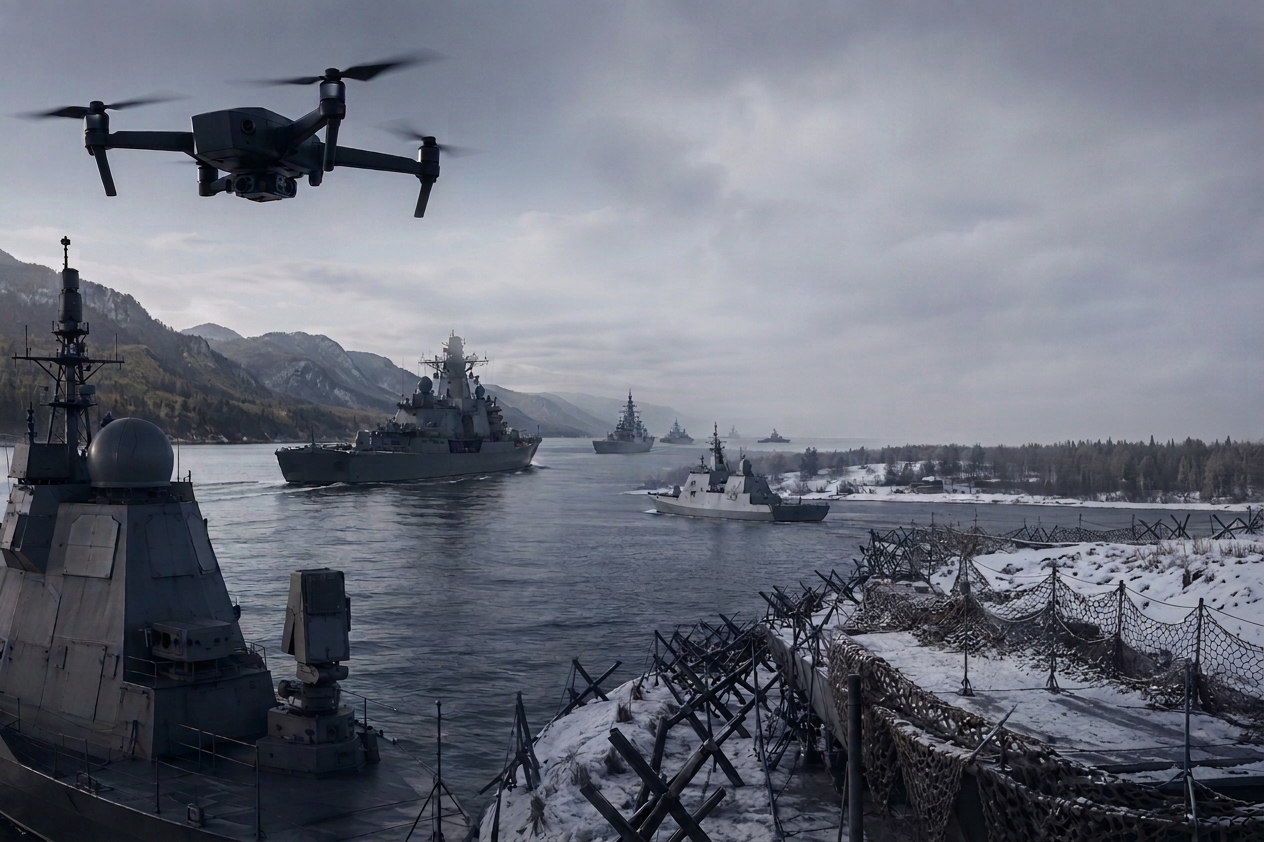
The Russian Navy is often left out of discussions about the war in Ukraine, except perhaps when the failure of the Black Sea Fleet (BSF) is brought up. Yet naval forces remain an integral part of Russia's territorial defense and power projection, and are continuously involved in the Special Military Operation (SMO) through missile strikes and personnel serving on the frontline. Particularly important are the Pacific and Baltic Fleets, which operate in some of the most geopolitically complex and strategically vital sections of Russia's borders. In this context, the question of the readiness of these Fleets to face and successfully counter modern threats on the battlefield becomes critical.
A quick look at the Black Sea Fleet's history over the last four years demonstrates why effective defense capacity against modern threats is so critical for any navy. According to Ukraine's Ministry of Defense, about 30% of the ships of the BSF have been neutralized or severely damaged. The naval force that once denied its adversaries access to the majority of the sea has now been forced to retreat to the Crimea and temporarily abandon operations it was traditionally designed to conduct in the event of war. The vast majority of the BSF's losses came from attacks by unmanned aerial vehicles (UAVs) and unmanned surface vehicles (USVs). According to some assessments, the absence of meaningful unmanned platforms and countermeasures meant that the Russian Navy in the Black Sea was simply not adequately trained or equipped to face this threat, contributing to the losses it incurred.
But what does effective unmanned systems defense actually require? In most cases, there is no single solution to the USV threat, and defense should be multi-layered to address attacks from different types of naval drones both effectively and efficiently. The widespread use of a fleet's own USVs, for example as early-detection platforms, can also significantly increase available reaction time. A study by Georgetown University also underlines the use of helicopter patrols as a particularly effective means of anti-USV defense. It would appear, however, that Russia's current approach follows a different logic. There is no universal drone-defense doctrine in the Russian Navy, so an individual examination of the Pacific and Baltic Fleets can help establish a better assessment and comparison of their respective approaches.
The Pacific Fleet of the Russian Navy is made up of more than 70 vessels and is surpassed in size perhaps only by the Northern Fleet. In addition to conventional forces, the fleet also includes nuclear-powered submarines carrying strategic nuclear capabilities. The Pacific Fleet was established in the 18th century to defend the Far East of the then-Russian Empire in the strategically crucial Pacific region and has participated in multiple conflicts. President Putin personally highlighted the importance of defending Russia's eastern borders when attending Pacific Fleet exercises last week.
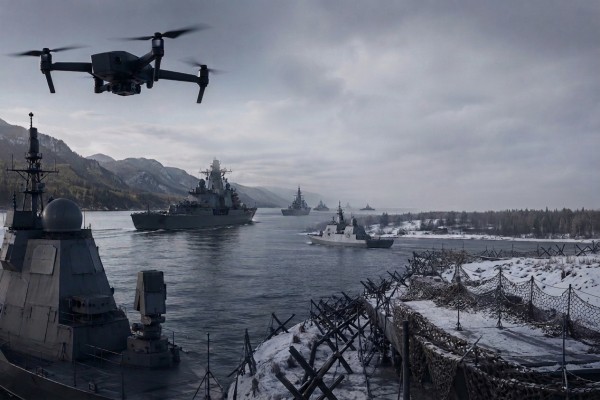
The command of the Pacific Fleet has long demonstrated a clear understanding of the threat drones pose to naval forces, with many recent drills integrating exercises in handling UAV threats. Footage from an early August exercise simulating a naval battle shows servicemen using large-caliber ship guns and regular assault rifles to defend against a simulated UAV and USV attack. Another exercise in late May demonstrated soldiers using shotguns to fend off what appear to be FPV UAV’s. There is evidence that these methods of aerial defense, also common among BARS mobile defense groups in Russia's regions, are not particularly effective against many types of modern UAV’s, especially during swarm attacks. Some more effective methods of anti-drone defense are also being used during training exercises, although perhaps not as widely.
For example, the exercises mentioned earlier reportedly used electronic warfare (EW) measures, which are potentially more effective than machine guns and shotguns. Additionally, Russian "Forpost" aircraft-type reconnaissance UAVs were used by the Pacific Fleet to identify targets during naval exercises.
Widespread use of such unmanned reconnaissance platforms could provide Russian ships with additional time and information to defend against enemy USVs in a real engagement. An anti-diversion group exercise in early June also saw the use of Ka-29 helicopters for target elimination. These aircraft can also be used for defense against enemy USVs, although the availability of these platforms for widespread use remains unknown.
The Pacific Fleet also actively takes advantage of opportunities for joint exercises and exchanges of expertise with friendly navies in the region. Such exercises have already been conducted with China, Indonesia, and Vietnam, with some incorporating defense against unmanned platforms into their programs. Finally, the planned establishment of a dedicated USV unit in 2027 has the potential to substantially improve the combat capability of the Pacific Fleet in a modern conflict, if implemented effectively.
Compared to the Pacific Fleet, Russia's Baltic Fleet is slightly smaller and consists of about 50 vessels of different sizes and roles. However, the Baltic Fleet's area of operation is no less critical, as it is positioned closest to NATO forces in Europe. Putin even described it as the primary line of defense of Kaliningrad when describing Russia's commitment to the defense of its European enclave.
In addition to its existing fleet, Russia's Navy in the Baltic Sea is actively acquiring new auxiliary and combat ships. One of the newly added vessels is the small rocket ship "Burya." The ship is armed with the "Pantsir-M" naval close-in weapon system (CIWS), which has already been tested against rocket threats and could prove effective against certain types of large UAVs.
Similar to the Pacific Fleet, the Baltic Fleet also conducts regular exercises that include defense against various unmanned platforms. The means of defense are very similar as well, as one recent exercise shows soldiers conducting shore defense against UAVs and USVs using mobile defense groups (MDGs) with standard equipment. As part of the same exercise, soldiers also practiced target shooting at FPV drones using shotguns at very close range. The same principle was followed in a different anti-diversion exercise, although this time sailors appeared to be using FPV drones for tactical reconnaissance. Similar UAVs were also used in an anti-terrorist exercise, demonstrating potential proficiency with the system through repeated use during training.
One of the more interesting means of UAV defense used by the Baltic Fleet is interceptor drones. During an exercise focused on the defense of basing points, Baltic Fleet servicemen used Russian-made "Yelka" interceptor drones to deflect an simulated enemy drone attack. No information on comparable use of interceptor drones by the Pacific Fleet has been made public. Since interceptor drones are considered by many to be more effective against UAV attacks than personal firearms or large-caliber weaponry, the testing of such equipment represents an important step toward enhancing the fleet's counter-drone capability. However, there is still little evidence to suggest that "Yelka" interceptors are widely used across the Baltic Fleet.
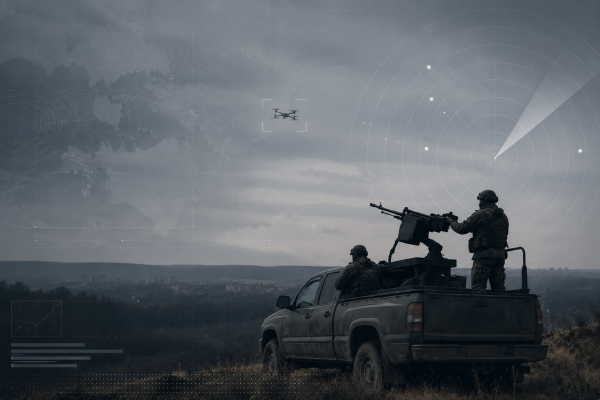
An overall assessment of training footage and official statements from both Fleets draws a mixed picture, albeit with clear room for improvement. It would appear that the majority of UAV defense operations during training are conducted using large-caliber guns, small arms, and, in some cases, specialized weapons such as shotguns. This pattern is consistent with the methods of Russian BARS MDGs, which overwhelmingly rely on shooting down Ukrainian drones with machine guns, suggesting the persistence of a more traditional doctrinal approach in the Russian Navy as well. Such a system of defense is cost-efficient and easy to employ on any vessel, but in the event of a large-scale UAV and USV attack, it is unlikely to be effective against all types of drones in most scenarios. A short case study of the Caspian Flotilla may provide a useful lesson for other naval formations.
The Caspian Flotilla has occasionally participated in strikes against Ukraine by launching ship-based missiles. As a result, Ukrainian forces conducted multiple strikes on the "Okhotnik" vessel of the Flotilla using сombat UAVs in late 2025. Consequently, the Flotilla worked to improve UAV defenses through multiple exercises. One of the exercises demonstrated sailors neutralizing drones with ship-based large-caliber guns. However, shortly after this series of exercises, Ukrainian forces conducted another series of successful drone strikes on two Russian vessels in the Caspian, together with several other targets. This is not to say that these means of defense are completely ineffective or that the experiences of the Caspian Flotilla can be clearly transferred to other fleets, but the case naturally raised questions about the effectiveness of conventional weapons against unmanned threats.
Nonetheless, the picture is not completely grim for the two Fleets. Evidence of the use of interceptor drones, reconnaissance UAVs, and naval CIWS suggests that the Russian Navy is willing to move beyond traditional means of defense and incorporate adaptations from other branches of the military. The Baltic Fleet appears to be more willing to use its own UAVs in exercises than the Pacific Fleet, but the establishment of a USV unit in the Pacific Fleet in 2027 could become one of the most meaningful developments in Russian naval adaptation.
Russia’s naval forces are clearly adapting to the growing threat posed by unmanned systems. The exercises examined in this article demonstrate that both the Pacific and Baltic Fleets are increasingly training to counter UAV and USV attacks, while the development of reconnaissance drones, electronic warfare systems, interceptor UAVs and dedicated unmanned-platform units indicates that the threat receives growing attention. However, adaptation remains uneven and, in many cases, continues to rely heavily on conventional weapons, including rifles, machine guns and large-caliber naval guns. These systems are not without value and can provide an important short-range or last-line layer of defense, but excessive reliance on them creates gaps that an opponent capable of conducting large-scale and technologically sophisticated drone attacks could exploit.
The experience of the Black Sea and Caspian Fleets further demonstrates that conducting counter-drone exercises does not necessarily translate into effective protection against real attacks. Russia has taken several steps in the right direction, particularly through greater use of electronic warfare and interceptor drones, but these capabilities do not yet appear to be widespread across its naval forces.
Overall, Russia is clearly responding to the lessons of the war in Ukraine, but its adaptation appears to be progressing more slowly than the development of Ukrainian drone technologies and tactics. If this gap continues to widen, Russian naval forces may risk falling behind the evolving unmanned threat.