

The Houthi Offensive and Iran’s Vision of a New Regional Order
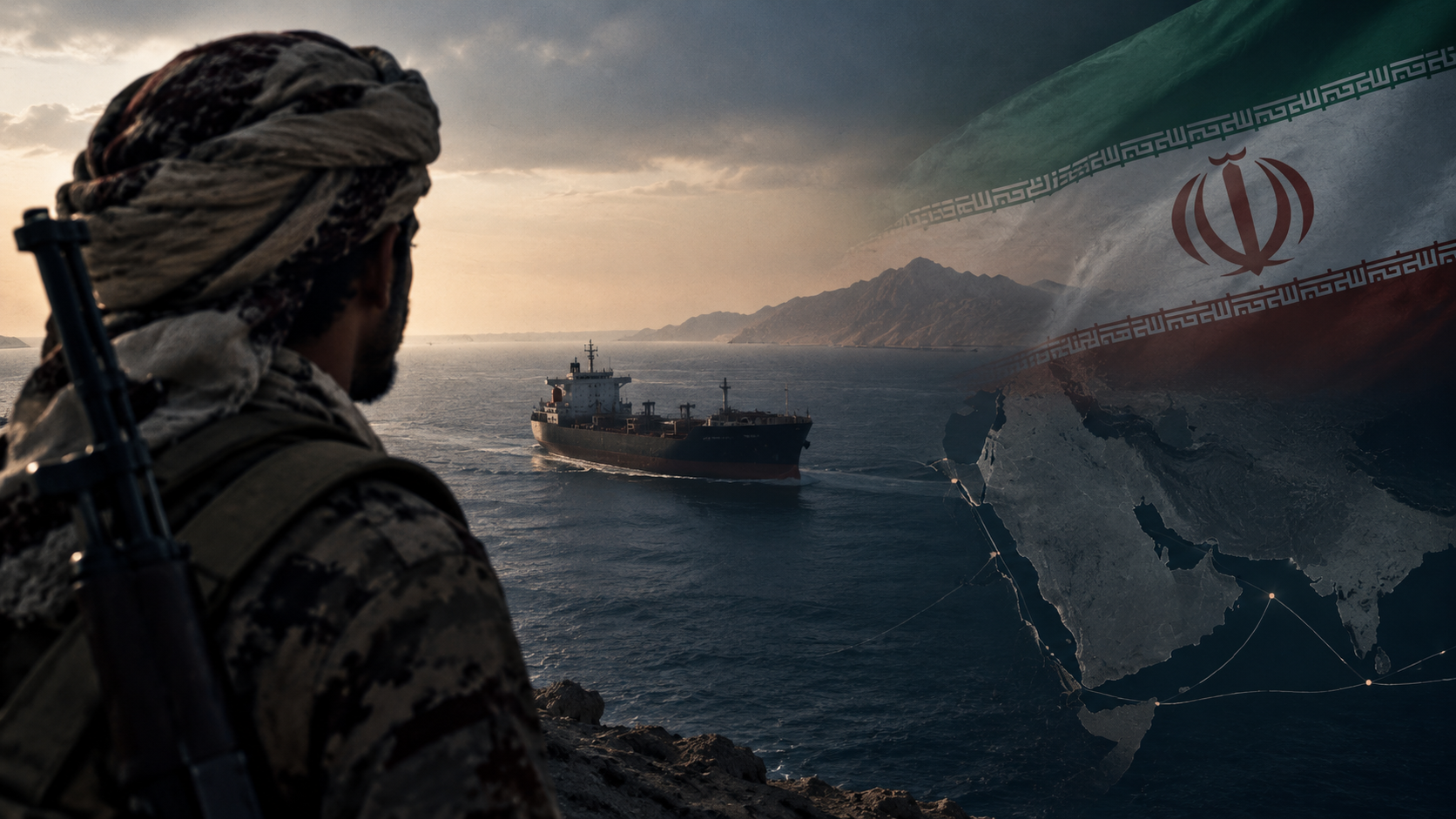
Throughout August, the United States seemed to be gradually gaining the initiative in the war with Iran. However, September produced precisely the opposite result: Tehran forced Washington into a new escalation in the Strait of Hormuz, while the Iran-backed Houthis launched a rapid offensive in Yemen. The latter development increasingly appears to be intended as a means of putting pressure on Saudi Arabia and other countries in the region. At the same time, Tehran has long been pursuing plans to reshape the regional order, the contours of which are becoming increasingly visible in statements by Iranian officials and articles in the Iranian press.
Regaining the initiative
By the end of August, there was a growing perception that the United States was gradually gaining the initiative in its confrontation with Iran. Against the backdrop of a relative lull in military activity, U.S. forces stepped up escorts for commercial vessels in the Gulf. On 28 August, the Trump administration reported that oil exports through the Strait of Hormuz had recovered to roughly two-thirds of their pre-war level. The Pentagon had previously stated that U.S. forces had completely cleared the strait of Iranian mines.
Clearly, statements from the U.S. administration should be viewed in the context of the broader information war. Independent data, for instance, suggested that traffic through the Strait of Hormuz had recovered to no more than one-third of its pre-war level. There are, however, two important caveats. First, a significant number of vessels were transiting the strait with their transponders switched off and may therefore not have been captured by open-source monitoring. Second, regardless of the precise figures, the trend was clearly upward, with the number of vessels using the strait increasing. This was also reflected in economic indicators. On August 28, amid expectations of higher flows through Hormuz, oil prices fell to $89 per barrel, marking a 5 percent decline over the week.
In effect, U.S. forces had managed to establish a security corridor along the Omani coast. At the same time, the maritime blockade of Iran remained in place. Tehran was therefore gradually losing its ability to control the strait while facing an increasingly acute crisis of its own, as the blockade severely constrained its ability to export and import through its southern ports.
However, this situation changed rapidly at the beginning of autumn. On 31 August and 1 September, both new incidents involving tankers struck by Iranian mines and attacks by Iranian forces against vessels transiting the strait were reported. The United States immediately responded with strikes on Iranian facilities, but rather than restoring stability, the move only broadened the escalation. Washington's strikes against Iranian tankers, under Trump's announced “tanker for tanker” strategy, likewise failed to produce de-escalation.
Estimates of the scale of the “tanker war” vary considerably depending on the source. According to Iranian data, Tehran struck as many as 18 vessels in September, although only three cases have been confirmed. Meanwhile, the United States destroyed at least 10 Iranian vessels during the same period, although this figure may also be higher. The key point, however, is that Iran succeeded in putting pressure on global energy markets. On September 9, even before the Houthi offensive in Yemen began, the price of oil broke the $101-per-barrel threshold.
Thus, the U.S. strategy of gradually stabilising the situation in the Gulf by establishing a security corridor has failed to deliver the intended result. By contrast, Iran’s strategy of exerting economic pressure on regional states and the United States through successive waves of escalation remains an effective instrument. Tehran’s main vulnerability remains the maritime blockade, which Iran has been able to circumvent only partially through overland routes.
In other words, economic pressure on Tehran from the United States is also mounting. For now, however, Iran’s economic situation appears worrying rather than critical. The Islamic Republic therefore continues to rely on military escalation and the deliberate destabilisation of the regional environment. So far, the United States has not found an effective means of deterring Iran along this axis.
Expanding the front
The current situation around the Strait of Hormuz cannot be described as entirely new. Rather, it represents a return to the status quo that prevailed in late spring and early summer this year. The Houthi offensive in Yemen, however, has been a more unexpected development, giving the conflict a new dimension. They initially launched a rapid advance and, by 10 September, captured the port of Mocha. On 11 September, they advanced southward to Dhubab, a town on the shores of the Bab el-Mandeb Strait. They subsequently began taking control of nearby islands, including Mayyun and the Greater and Lesser Hanish islands. By September 17, they controlled the entire Yemeni coastline along the Red Sea.
The rebels’ rapid gains against the Saudi-backed government forces can be attributed to several factors. First, the element of surprise played a significant role. The Houthis managed to concentrate around 100,000 fighters with considerable secrecy, pointing to a major intelligence failure on the opposing side. Second, the limited combat effectiveness of Yemen’s government forces was an important factor. Until 2019, this weakness was partly offset by the deployment of Sudanese mercenaries, whose contingent numbered as many as 15,000 personnel. Following the coup in Sudan and the overthrow of Omar al-Bashir, however, the withdrawal of the contingent began, and by 2020 Sudanese troops had almost completely left Yemen. In addition, the UAE began withdrawing its forces from Yemen in 2019. It was with Emirati support that some of the most capable units of the government forces had been established.
Finally, the Saudi Air Force has also performed poorly. As Russian military analyst Yuri Lyamin notes, “over the years of the war, the Saudi air force has still failed to learn how to provide timely support to its proxies on the ground.” Coordination between the air force and ground forces, as well as the speed of response to emerging threats, appears to have been particularly inadequate. When the front remains relatively static, these weaknesses are less pronounced. In the face of rapid enemy breakthroughs, however, they become critical.
In terms of the strategic consequences, the Houthis have for the first time acquired much more direct means of exerting influence over the Bab el-Mandeb Strait. In other words, they are now capable of disrupting shipping through the Red Sea.
It is this potential threat to international transport routes that has drawn the greatest concern from international media. At present, however, the Houthis are not blockading the waterway, and representatives of the movement have pledged to guarantee freedom of navigation. Only Saudi vessels are being denied passage.
There is also evidence that the Houthis’ immediate objective is Saudi Arabia rather than international shipping. This is suggested by leaks concerning talks between the Yemeni movement and the United States in Oman. The U.S.-based Institute for the Study of War suggests that the Houthis are interested in avoiding an escalation with Washington while maintaining pressure on the Saudis. In other words, the Yemeni rebels have strengthened their strategic position and acquired the ability, if they choose, to influence the international agenda. For now, however, their objective appears to be narrower and more pragmatic.
Pressure on Riyadh
Region observers tend to describe the Houthis not as an Iranian proxy force, but as allies of Tehran. In other words, the Yemeni rebels’ offensive appears to be primarily their own initiative, although it nevertheless serves the interests of the Islamic Republic. Tehran is therefore seeking to amplify the impact of Houthi actions through coordination with other components of the Axis of Resistance.
Against the backdrop of their gains in Yemen, the Houthis, together with pro-Iranian forces in Iraq, have launched a campaign targeting Saudi Arabia’s energy infrastructure. Particularly damaging was an attack by Iraqi forces on the East-West oil pipeline. As a result of damage to oil infrastructure and Houthi attacks on Saudi tankers, Riyadh effectively suspended oil shipments through the Red Sea in September. At the same time, exports through the Strait of Hormuz have also been disrupted by the U.S.-Iran war.
Saudi Arabia appears to be a logical “weak link” for Tehran. The country has been significantly affected by the consequences of the war launched by Trump. Moreover, Riyadh has developed serious disagreements with Washington, which has now declined to help the Saudis repel Houthi attacks. The current situation could place Riyadh in an increasingly desperate position: despite its efforts and the availability of oil terminals on both the Persian Gulf and Red Sea coasts, Saudi Arabia could find itself unable to export its oil.
Against this backdrop, Tehran continues to signal its readiness for negotiations with Riyadh and other regional powers. The two sides are known to have maintained contacts in recent weeks. On 9 September, Saudi Arabia sent a message to Iran asking it to use its influence over the Houthis. On 17 September, a similar message was delivered through China.
In other words, as the prospects for resolving the issue through negotiations with the United States diminish, Tehran is increasingly turning toward regional dialogue. At the same time, it is not shying away from using force as a means of exerting pressure, relying both on its own armed forces and on the capabilities of its allies across the Middle East. That this strategy is not without logic is also suggested by media leaks. On 13 September, Reuters, citing sources in Gulf countries, reported that the combination of pressure on the Strait of Hormuz, the Houthi offensive, and Washington’s reluctance to fight the Houthis is pushing the Arab monarchies toward the conclusion that reaching an understanding with Tehran is becoming less a choice than a necessity.
The main question, however, is what such an understanding could actually be based on. Negotiations are possible, but two issues remain critical: first, would Iran’s demands be acceptable to the Gulf states; and second, could such demands be implemented given Trump’s apparent opposition to any such arrangements? Clearly, a U.S. response—including sanctions—could have consequences for these countries that are no less damaging than Iranian attacks.
Tehran's Grand Strategy
According to well-known Iran analyst Vali Nasr, Iran’s grand strategy based on the assumption that the region has entered a period of inevitable transformation. Tehran’s approach rests on two key assumptions:
1. The future of the Middle East will be shaped against the backdrop of declining U.S. influence.
2. This transformation is generating numerous contradictions among the region’s traditional partners.
On the one hand, Iran therefore sees significant opportunities to shape regional developments by exploiting emerging divisions. On the other, the future appears increasingly chaotic, which in turn means reduced military and economic pressure on Iran.
Official statements by Iranian authorities provide somewhat greater detail on Tehran’s vision. In a recent speech on 19 September, Iranian Foreign Minister Abbas Araghchi discussed the crisis of authority facing international institutions, including the United Nations. In this context, he offered the following recommendations for the region: “In the Middle East, sustainable security cannot be dictated from outside the region; regional security must belong to the region itself, and the countries of the region must be able to discuss their security <…> without the intervention of foreign powers.”
The idea of regional dialogue is elaborated in greater detail in an article by Pars Today, a division of Iran’s state broadcaster, which summarizes a statement by Parliamentary Speaker Mohammad Bagher Ghalibaf and adds editorial explanations of what the politician meant. The article emphasizes the need to establish a new security architecture for the Middle East. The text stresses that this is not about creating a pact or alliance, but rather a “set of rules, understandings, confidence-building mechanisms and forms of cooperation capable of regulating conflicts among the countries of the region.”
The article also makes clear which direction is considered particularly important today: “Iran’s relations with the Arab countries of the region are also of decisive importance; without the participation of the major players in the Persian Gulf and mutual understanding among the regional powers, a comprehensive security architecture cannot be established.” At the same time, it emphasizes Iran’s intention to play a central role in this process: “Tehran intends to present itself not simply as an opponent of the existing order, but as one of the architects of an alternative order.”
Some elements of this plan were outlined as early as 27 June by Babak Negahdari, head of the Majlis Research Center. He explicitly stated that “the Axis of Resistance should become part of the security architecture.” He also argued that “the Strait of Hormuz should be transformed from a purely geographical chokepoint into a strategic asset for building Iran’s political, economic and geopolitical power.”
The role of Iran’s network of proxy forces is also addressed in an article published by Tasnim, an agency close to the IRGC. It focuses on the “strategic link between the Strait of Hormuz and the Bab el-Mandeb Strait within the framework of the ‘Axis of Resistance’ doctrine.” The authors call on Iran and its allies, drawing on their geographic advantages, to “transform themselves from a purely defensive coalition into an actor capable of directly influencing international politics and the global economy.” To support this argument, the article calculates what share of global trade and energy flows passes through the Strait of Hormuz and the Bab el-Mandeb. Notably, the article was published on 1 August, more than a month before the start of the Houthi offensive in Yemen.
In sum, Iran’s concept of regional security rests on several key elements. At its core should be a set of understandings and rules—whether formal or informal—among the countries of the region, while the United States should remain outside this process. The Axis of Resistance is not only expected to survive; it is also intended to become an important component of the new security architecture. At the same time, the Strait of Hormuz and the Bab el-Mandeb are being conceived as instruments for influencing the formation of a new regional order, helping Tehran and its allies advance their interests.