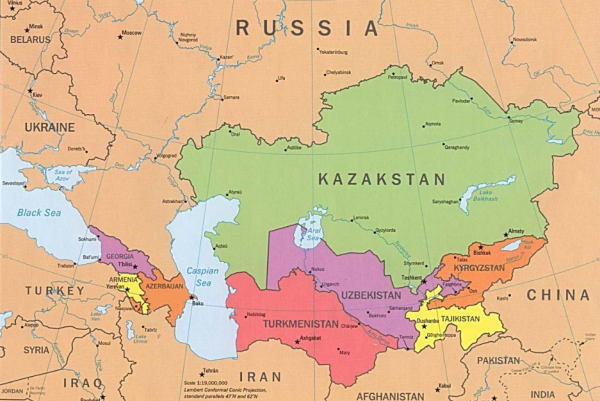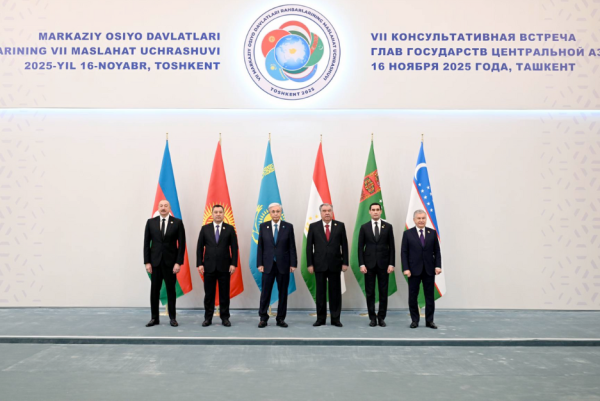

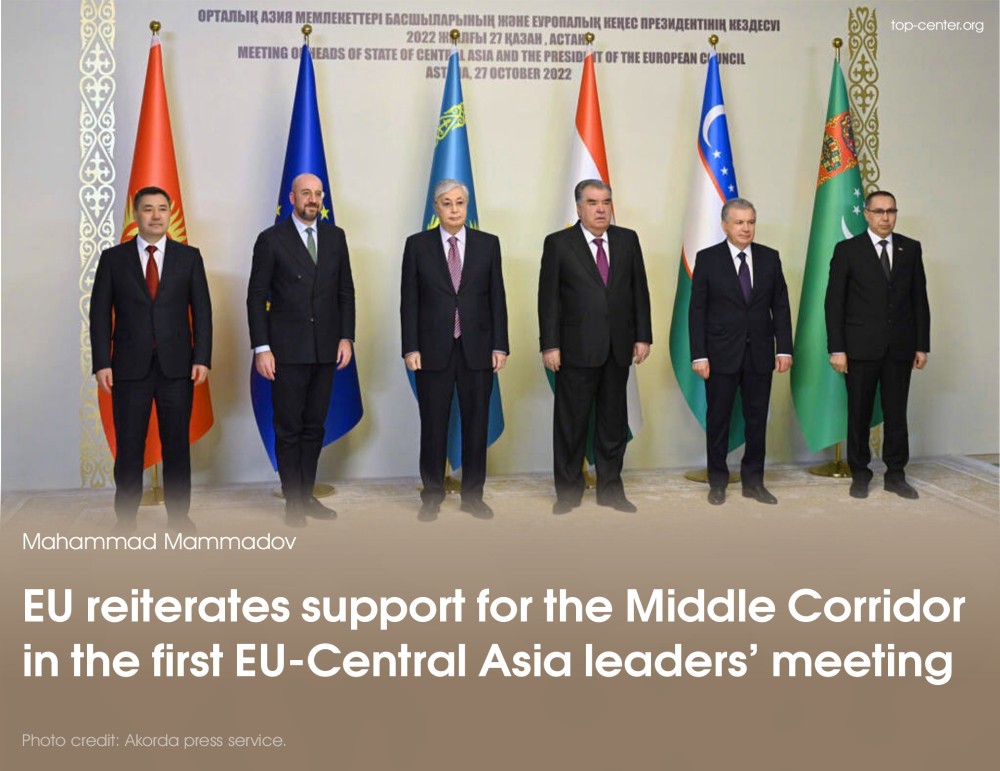

On October 27, Kazakhstan's capital Astana hosted the first EU-Central Asia leaders’ meeting - a diplomatic feat of sorts against the background of the geopolitical kerfuffle over Russia’s invasion of Ukraine. Among the issues discussed, boosting the transport capacity of the Middle Corridor received particular attention as the EU and Central Asian countries seek urgent solutions to connectivity bottlenecks in the east-west rail trade passing through South Caucasus and Central Asia.
After Russia’s aggression against Ukraine destabilized the Kazakhstan-Russia-Belarus route, the EU and China are yet to put their weight behind alternative transport networks to keep rail cargo flowing between the two sides. In her visit to Azerbaijan in July 2022, President of the European Commission Ursula von der Leyen said the EU is closely following the new developments around the Middle Corridor and Brussels wants to work with Azerbaijan to build connections with Central Asia and beyond. As a crucial follow-up, President of the European Council Charles Michel, in his meeting with Central Asian leaders, said the EU is ready to support multilateral efforts to increase the capacity of the Middle Corridor. The participating countries expect the EU to play a more active role in improving the route’s hard and soft infrastructure capabilities, including but not limited to, expanding port capacities, improvement of railroad networks, and introducing IT solutions for cargo handling.
In this context, the EU-Central Asia Sustainable Connectivity Conference in Samarkand on November 18 will provide a platform for intra- and inter-regional dialogue on shared concepts that will help translate the goals of resilience and regional cooperation set out in the EU Central Asia Strategy (2019) into action. It will also be the first regional conference on connectivity since the adoption of the EU’s €300 billion Global Gateway strategy in December 2021. Brussels is expected to present two Global Gateway initiatives on water, energy, climate change, and digital connectivity with an aim to boost sustainable connectivity in the region.
The sides will also discuss prospects of connecting the EU’s Trans-European Transport Network (TEN-T) - a planned network of roads, railways, airports, and water infrastructure - with networks in Central Asia as mentioned in the EU Central Asia strategy. Brussels extended the TEN-T to Georgia and Azerbaijan in 2019. Furthermore, the Economic and Investment Plan adopted in 2021 allocated financial assistance to increase their transit capacities in the Black Sea and the Caspian Sea, respectively. The creation of a smooth linkage between these two otherwise “weaker” legs of the Middle Corridor will only add to its ability to attract additional cargo diverted from the Northern route.
The EU’s proactive stance on strengthening the Trans-Caspian routes has serious implications for Brussels’ and Middle Corridor countries’ standing in a highly destabilized neighborhood. First of all, it will contribute to efforts for diversification away from dependence on increasingly unpredictable Russia for strategic raw materials and cargo transit. Azerbaijan and Kazakhstan, major stakeholders in the Middle Corridor, need secure and functioning trade corridors to reach the EU market, their largest export partner. On its side, the EU will have access to alternative markets for raw materials where Central Asian countries have untapped potential. According to President Michel, the EU and Kazakhstan will sign a Memorandum of Understanding on strategic partnership on sustainable raw materials, batteries, and renewable hydrogen value chains in the upcoming meeting.
Greater EU financial and technical assistance opens up certain avenues for integrating the region into European and global supply and value chains. Since Russia’s invasion of Ukraine and ensuing Western sanctions on Russia, Azerbaijan and Kazakhstan have taken remarkable steps to optimize transport solutions between the ports in the Caspian and Black Seas. In the Caspian Sea, the two countries have agreed to double the number of vessels sailing between the port of Aktau and the port of Alat from three to six. In the Black Sea, Azerbaijan’s ADY Container launched a ferry service linking the Georgian ports of Batumi and Poti with Romania’s port of Constanta. On September 5, Azerbaijan Shipping Company’s (ASCO) “Rasul Rza” ship delivered 24 containers of mineral fertilizer dispatched from Uzbekistan to Constanta port along this line. The EU support under the TEN-T program would further help connect the region to the east-west link across continental Europe - the Rhine-Danube Corridor starting in Romania’s Constanta Port.
Besides economic resilience, pro-active EU involvement in regional connectivity helps ensure sustainable peace in the South Caucasus and Central Asia. Brussels’ successful mediation of Armenia-Azerbaijan peace talks based on the principles of the inviolability of borders and territorial integrity, not only increases the prospects of the Middle Corridor as a stable route between the EU and China but by creating new interdependencies involving Armenia it can contribute to the emergence of a new regional status quo which meets the interests of all sides.