
Topchubashov Center
Expert opinion 2 min read

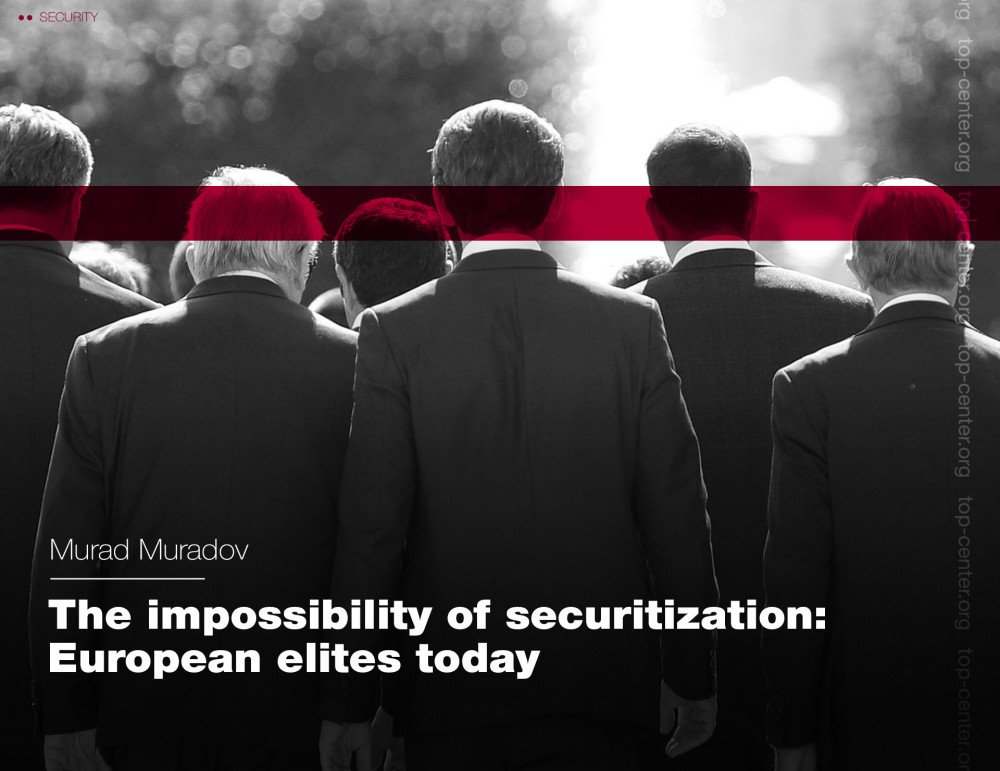
The impossibility of securitization: European elites today

The impossibility of securitization: European elites today
Murad Muradov Co-founder, Deputy Director Published

Listen to this article Read by an AI voice

The current situation in Europe reveals a very important peculiarity of contemporary European politics as such. There are few doubts left that decline in major economic and social parameters in the coming months and maybe years will be of the scale that is normally supposed to trigger a government downfall, to say the least. The unexpectedly high support for the no-confidence vote on UK Prime Minister Johnson from his own Conservative Party has been just one of the many telling signs. Even if Western European countries fully shed any political responsibility in the Ukraine crisis and do as much as it is politically tenable to pacify Russia, they can hardly avert the upcoming crisis: the changes in global politics and economy since 2020 have been too profound for them to simply return to “business as usual”.

However, European politicians, at least in the mainstream, spectacularly shy away from openly admitting these prospects and recognizing that economic performance right now cannot be assessed by the standards of the "normal" times, because withdrawing "normal-time" responsibilities will require them to take over emergency ones. Though French President Macron and some European leaders have already claimed that this war will most possibly be long and will have a strong negative effect on the European economy, no one as of yet has frankly explained to Europeans what kind of problems they must be ready to face; there is very little debate on the emergency plans to be prepared for the possible consequences, either. And here we come to the point- European statesmen whose vision is fixed in the de-politicized, technocratic EU paradigm, are not capable of proper and consistent "securitization"- the process under which Thierry Balzacq understood changing the status of a certain political issue from a general one (resolved through electoral politics and routine policy-making) to the security one, which presupposes insulating it from public pressure and treating as a strategy-shaping problem. Having preached technocracy and consensus decision-making for a long time, the EU elites - and most national elites in Europe- seem to have lost the vision of politics as an arena of constant conflicts and emergencies. Even faced with the possibility of losing power, they cannot dare to move from the soothing vision of reality the technocratic paradigm offers.

Related work

Expert opinion

US foreign policy before midterm election

As the US midterm election is approaching, the correlation between President Trump’s statements and actual US policies, gets more and more uncertain. And while his occasional eccentricities on Twitter or during rallies with supporters, have become part of a po...

Murad Muradov, 27 October 2026

Expert opinion

Connecting Central Asia and the South Caucasus

On November 15, Azerbaijan formally joined the Central Asian Consultative Meetings, expanding what was known as the Central Asian Five (C5) into a Central Asian Six (C6). Many in Central Asia find it surprising. But when viewed through the lens of recent geopo...

Gulkhanim Mammadova, 1 December 2025

Expert opinion

Azerbaijan joins the C5: implications for Eurasian regional architecture

When the long-standing C5 format of Central Asian cooperation formally expanded into a C6 on 15 November in Tashkent, Azerbaijan’s accession was framed as a natural extension of historical and linguistic affinities. Yet behind the rhetoric lies a structural tr...

Gulkhanim Mammadova, 21 November 2025

Expert opinion

Kazakhstan joins the Abraham Accords: Pragmatism or Symbolism?

Kazakhstan’s accession to the Abraham Accords—anticipated in some political circles—may still raise eyebrows. Unlike the original signatories, who were establishing relations with Israel from scratch, Kazakhstan has long maintained cordial ties with the Jewish...

Rusif Huseynov, 9 November 2025

Expert opinion

13 June attack: quick comments

In the most extensive attack on Iran since the country’s 1980-88 war with Iraq, Israeli forces have launched multiple waves of nationwide bombings. The attack is ongoing and believed to be the opening shots of a wider campaign to degrade Iran’s military comman...

Murad Muradov, 13 June 2025

Expert opinion

Historic First in Tbilisi: Armenia, Azerbaijan and Georgia trilateral talks

On April 17, Tbilisi hosted the first-ever formal trilateral meeting between the foreign ministries of Armenia, Azerbaijan and Georgia. According to official statements, the primary aim of the meeting was to create a platform for open dialogue and to explore p...

Gulkhanim Mammadova, 17 April 2025

Expert opinion

Munich speech, 18 years later

The Munich speech of the U.S. Vice President J. D. Vance will definitely enter the textbooks of the future as one of the harbingers of a new historic period. This speech has been arguably more shocking than Vladimir Putin’s diatribe he made on the same stage 1...

Murad Muradov, 19 February 2025